Safety first: this problem can involve gas, refrigerant or high voltage. Use this guide to understand the issue, and have a licensed technician do any repair inside the appliance.
Prefer a technician? Find a Rinnai PRO(official Rinnai site)
Rinnai Code 11: No Ignition, What to Check Before You Call
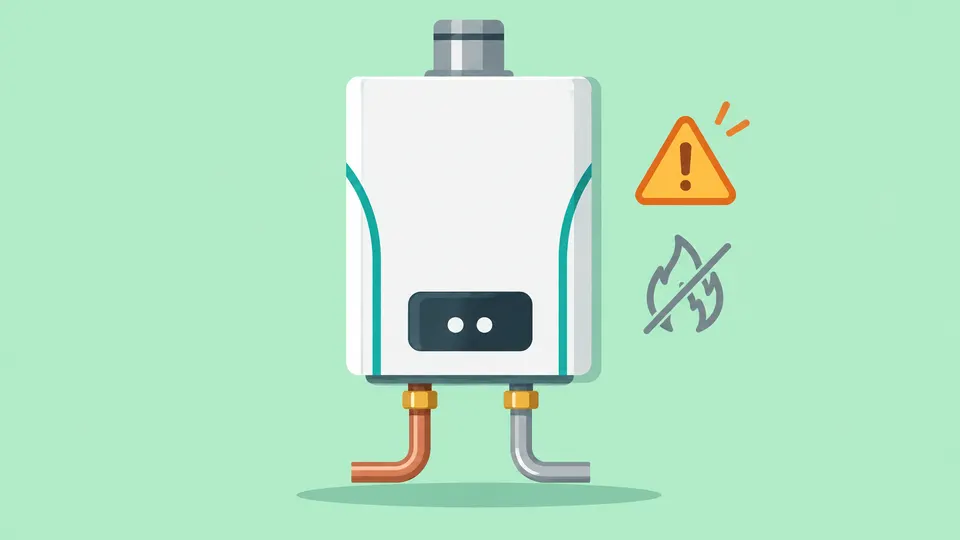
Quick Answer
Rinnai code 11 is "No Ignition": the tankless water heater did not light and confirm a flame. Check that the gas valves are open and, on propane, that the tank has gas. Look at the vent end outside and try one off-and-on reset. If code 11 returns, call a licensed gas technician; igniter, flame rod, gas pressure and gas valve work is not a DIY job. If you smell gas, leave the home and call your gas utility.
On this page
Key Takeaways
- Rinnai's diagnostic guide lists code 11 as "No Ignition" for its SENSEI, SENSEI RX/CX and Non-SENSEI tankless series.
- Owner checks are limited to the gas valves, the propane tank level, a look at the outside vent end and one reset. Do not open the cabinet.
- Igniter, flame rod, gas pressure, gas type and altitude settings, the gas valve and the control board are technician jobs.
- If code 11 returns after one reset, stop resetting and call Rinnai or a licensed gas technician.
- If you smell gas, do not touch switches or phones inside; leave the home and call the gas utility from outside.
What does Rinnai code 11 mean?
Rinnai's own diagnostic guide lists code 11 as "No Ignition" and says it applies to all three of its tankless families: the SENSEI Series, the SENSEI RX/CX Series and the Non-SENSEI Series [1]. In plain terms, we read this as the water heater calling for heat and not getting a confirmed flame from its burner. That is why searches say "rinnai error code 11", "rinnai tankless code 11" and "rinnai code 11 no ignition" for the same thing.
The code tells you the unit stopped trying to light; by itself it does not say which part failed. Rinnai says error codes vary by product and tells owners to contact Rinnai or a local installer to find the root cause [2]. You can find your model number on the rating plate, which Rinnai says sits on the side of the water heater [1].
The neighbouring codes are easy to confuse. Rinnai names code 10 "Air Supply, Exhaust Blockage or Condensate Trap is Full" and code 12 "Flame Failure" [1]. If your display shows something other than 11, our error code lookup can point you to the right entry.
Code 11 is a gas-appliance fault, and Rinnai's own guide is written for trained and qualified professionals. The same guide opens its safety section by saying only such professionals are permitted to follow its instructions [1]. This article therefore splits the work in two: a short list of checks an owner can do from outside the cabinet, and a longer list of jobs to leave to a technician.
What causes Rinnai code 11?
Rinnai's troubleshooting steps for code 11 read like a checklist of everything the burner needs in order to light: gas, a spark, a way to sense the flame, and clean air and venting [1]. The table groups the causes it names and says who should handle each.
| Cause named by Rinnai | What it means | Who fixes it |
|---|---|---|
| Gas valves closed | A valve on the gas system is not fully open | You |
| Empty or undersized propane tank | Not enough gas reaches the unit | You (check level), supplier or technician (sizing) |
| Air in new gas lines | Air was not purged after installation | Installer or gas technician |
| Low inlet gas pressure | The supply cannot keep up when all gas units fire | Licensed gas technician |
| Wrong gas type setting | The unit is set for natural gas but runs on propane, or the reverse | Installer or technician |
| Igniter or spark problem | No spark, a loose connection or a damaged part | Technician |
| Loose or dirty flame rod | Carbon or a white buildup, or a "floating" rod that is not tight in its bracket | Technician |
| Vent clearance or length problems | Exhaust is recirculating or the vent is the wrong length or material | Installer or technician |
| Failed gas valve or control board | A part that does not open the gas valve or send the right signal | Technician |
Two details from the guide are worth knowing. First, on Non-SENSEI models Rinnai says a loose flame rod, which it calls a "floating" flame rod, "will result in a code 11" (and sometimes a code 12) [1]. Second, the guide says that if you can see a flame through the view glass while the unit cycles but the flame then goes out, the problem is in the flame sensing circuit or the gas system, such as carbon on the flame rod, a bad connection, low inlet gas pressure, a bad control board or a defective gas valve [1]. That is a technician's diagnosis, not a cue to open the cabinet.
What can you safely check before you call?
Rinnai's guide puts the gas supply first, and these are the checks that do not require opening the water heater [1].
Step 1: Confirm the gas is on
Rinnai's first step is to verify that all gas valves on the system are open. If the system runs on propane, make sure there is gas in the tank [1]. Rinnai does not describe how to read a valve, so check the valve's labeling or your owner's manual. If you see a closed valve you did not close yourself, do not force anything; call the installer.
In our view, a quick look at another gas appliance, such as a gas range burner, can tell you whether gas is reaching the house at all. That is our suggestion, not a Rinnai step.
Step 2: Look at the vent end outside
Rinnai says that failing to meet the clearances around the outside vent terminal can lead to recirculation of combustion gases and incomplete combustion [1]. You cannot judge clearances from the ground, but you can notice whether leaves, debris or a drift of snow is covering the vent end. In our reading, an obstructed terminal is the kind of problem worth clearing from outside, if you can do it safely from the ground. Do not disconnect any vent pipe.
Step 3: Power-cycle once and run a hot tap
Rinnai's code 11 entry does not list a homeowner reset, and its reset instructions differ by code. For the code 03 entry, for example, it says to press the ON/OFF button on the controller twice [1]. For code 11, check your owner's manual for how your controller clears a code. If the manual is silent, we think a single off-and-on cycle at the controller is a reasonable test, followed by one hot tap to trigger the heater. Treat it as a test, not a repair.
If code 11 comes back after one reset, stop resetting and call for service. Repeated restarts do not fix a gas, spark or flame-sensing fault.
What should only a technician do?
Everything below sits behind the front panel or in the gas system. Rinnai's guide tells the technician to turn off the gas valve, the electrical power and the water supply before several of these steps, and it warns against adjusting the internal gas valve [1].
| Job | Why Rinnai lists it |
|---|---|
| Test the igniter spark and its wiring | A missing spark means loose connections, damaged parts or a board problem |
| Check electrode gap, tightness of the sparker and flame rod, and the gasket | Rinnai says a loose rod must be cleaned and reinstalled with a new gasket |
| Clean carbon or white buildup from the flame rod and igniter | Buildup can stop the unit sensing the flame |
| Measure inlet gas pressure at high fire | The minimum on the rating plate must be held with every gas unit firing |
| Check the gas type and altitude settings | Rinnai lists both as settings to verify when the unit will not ignite |
| Inspect vent length, joints, materials and clearances | Recirculated exhaust causes incomplete combustion |
| Check the two-stage regulator on propane | It must not push pressure past the unit's maximum when the heater shuts off |
| Replace a gas valve or control board | Rinnai lists both as possible causes if everything else checks out |
For the inlet pressure checks, Rinnai's guide says the gas system may be undersized if pressure drops by more than 0.3 inches of water column on natural gas, or 0.5 on propane, when every gas unit in the building fires on high (Non-SENSEI guidance), and that pressure should not exceed 10 inches water column for natural gas or 13.5 for propane when the heater shuts off [1]. These figures are for a trained technician with a manometer. They are not a home test.
The gas type and altitude settings are worth mentioning to anyone who just moved in or bought a unit. On SENSEI models Rinnai names Parameter 10 as the gas type (A for natural gas, B for propane) and Parameter 02 as the altitude setting; Non-SENSEI models use DIP switches [1]. If a new install shows code 11 on its first day, ask the installer to recheck the gas type setting and the purging of the gas lines, because Rinnai lists both among its first checks.
Is it safe to keep trying a unit that shows code 11?
Do not keep cycling it. The unit is refusing to run because it could not confirm a flame, and the person who should decide whether it can run again is a technician.
Rinnai's safety section gives a clear rule for gas smell, and we repeat it here [1]:
- Do not try to light any water heater.
- Do not touch any electrical switch, and do not use any phone in your building.
- Call your gas supplier from a neighbor's phone and follow its instructions.
- If you cannot reach the gas supplier, call the fire department.
If you smell gas near the water heater, leave the home first and call your gas utility from outside. Rinnai also tells owners to smell next to the floor, because some gas is heavier than air and settles there.
Carbon monoxide is the other reason to take the vent seriously. Rinnai links vent clearance failures to recirculating exhaust and incomplete combustion [1]. The U.S. Consumer Product Safety Commission describes carbon monoxide as a colorless, odorless, poisonous gas and recommends CO alarms on every level of the home and outside sleeping areas. It lists headache, dizziness, weakness, nausea, vomiting, sleepiness and confusion as symptoms, and says to get outside to fresh air and call 911 if you suspect poisoning [4].
Who should you call, and what should you have ready?
Call a licensed gas technician or the installer who set up the unit. Rinnai's support page offers a "Find a PRO" search for a local installer or service provider, and lists live chat Monday to Friday, 8 a.m. to 8 p.m. Eastern [3]. Rinnai's Customer Care line on the error codes page is 1-800-621-9419 [2].
Have this information ready:
- The model number from the rating plate on the side of the unit.
- Whether the heater runs on natural gas or propane.
- Whether the unit is new, was moved, or recently had gas work done.
- Whether you checked the gas valves, and what you saw outside at the vent.
- Whether code 11 returned after a single reset.
If you are comparing other water heater problems, our water heater guides group them by symptom, and the Rinnai brand page collects every Rinnai guide. Another gas appliance with a similar "check the gas, then the vent" pattern is covered in our guide to an LG dryer D80 code and in our guide to a dryer that is not heating. For how we handle safety topics, see our editorial policy.
Frequently Asked Questions
What does Rinnai code 11 mean?
Rinnai's diagnostic guide names code 11 "No Ignition" and lists it for the SENSEI, SENSEI RX/CX and Non-SENSEI tankless series. We read it as the unit not getting a confirmed flame. The guide's causes include closed gas valves, an empty propane tank, air in new gas lines, low inlet gas pressure, igniter or flame rod problems, venting problems and failed parts.
Will resetting a Rinnai water heater clear code 11?
It may clear the display, but a reset does not fix a gas, spark or flame sensing fault. Rinnai's code 11 entry lists no homeowner reset, so check your owner's manual for your controller. If code 11 returns after one reset, call a licensed gas technician rather than resetting again.
Can I clean the flame rod or igniter myself?
We do not recommend it. Rinnai's guide describes removing the igniter and flame rod assemblies with the gas, power and water off, and replacing the gasket if its seal is broken. That is gas appliance service work for a trained technician.
Why does code 11 show up on a new Rinnai installation?
Rinnai's checklist starts with items an installer controls: all gas valves open, air purged from the gas lines, proper inlet gas pressure and the right gas type setting. Ask the installer to recheck those first.
Our Take
Our Take: Code 11 is a case where the manufacturer's own document tells you who should do the work. Rinnai's guide is written for trained professionals, and most of its steps involve gas pressure, spark testing and removing parts behind the front panel. We think the sensible owner routine is short: confirm the gas is on, look at the vent end from the ground, try a single reset and then stop. A heater that keeps failing to light is giving you a reason to call, not a challenge to solve. If the unit is new or recently moved, we would start by asking the installer to recheck the gas type setting and the purge of the gas lines, since Rinnai lists both first. The gas smell rule is the one part we would never skip.
Sources
- Troubleshooting Tankless Water Heater Diagnostic Codes. Rinnai.
- Error Codes. Rinnai America Corporation.
- Support. Rinnai America Corporation.
- Carbon Monoxide Information Center. U.S. Consumer Product Safety Commission.
Repair information is general guidance. Unplug the appliance and shut off water or gas before working on it, follow your owner's manual, and call a qualified technician for gas, refrigerant or high-voltage work. Spotted an error? Tell us.
Related Fixes
Tankless Water Heater Installation Cost: Gas, Electric and Retrofit Prices
Tankless water heater installation cost: reported price ranges, what drives them (gas, electric, venting, permits, removal) and how to decide repair or replace.
How Long Do Water Heaters Last? Lifespan by Type and Warning Signs
How long do water heaters last? See tank and tankless lifespan ranges from DOE and manufacturers, warning signs, and when to repair or replace yours.
Water Heater Replacement Cost: What You Will Pay and Why
Water heater replacement cost explained: national price ranges for tank, tankless and heat pump units, what labor, permits and venting add, and when to repair.
Tankless Water Heater No Hot Water: Flow, Gas, Vent and Error Code Checks
Tankless water heater giving no hot water? Check flow rate, the cold water sandwich, gas valve, vent and error codes, and see which fixes need a gas technician.
Water Heater Pilot Light Won't Stay Lit: Causes and When to Call a Pro
Water heater pilot light won't stay lit? See the common causes, the few safe checks, how to relight per your label, and when to call a licensed pro.
Water Heater Not Heating? Gas and Electric Checks That Find the Cause
Water heater not heating? Check the breaker, reset button, gas supply and faucets first, then see which repairs need a licensed plumber or gas technician.