Safety first: this problem can involve gas, refrigerant or high voltage. Use this guide to understand the issue, and have a licensed technician do any repair inside the appliance.
Water Heater Pilot Light Won't Stay Lit: Causes and When to Call a Pro
Quick Answer
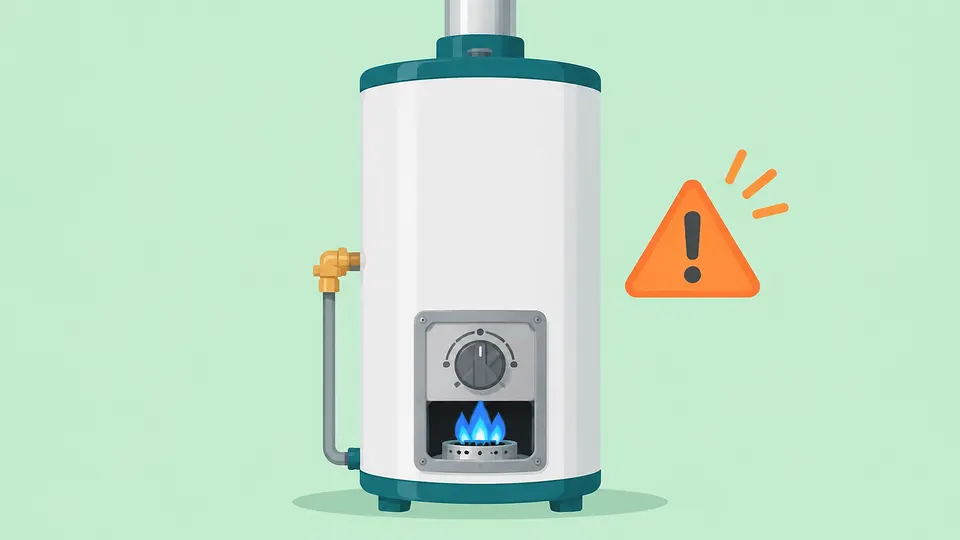
A water heater pilot that lights while you hold the knob but goes out when you let go usually means the flame-sensing safety circuit is not holding the gas valve open, often a worn thermocouple or thermopile. Blocked air, a gas supply problem or a flammable vapor shutdown can do the same. Check for gas smell, the gas valve and air inlets, relight once per your label, then call a technician.
On this page
- Why does a water heater pilot light go out right after you light it?
- What should you do first if the pilot keeps going out?
- What usually makes a pilot light go out?
- Could flammable vapors or a blocked air inlet shut the heater down?
- Can you replace the thermocouple yourself?
- When should you call a professional, and what about carbon monoxide?
- Frequently Asked Questions
- Our Take
- Sources
Key Takeaways
- If you smell gas, do not light anything or touch switches or phones inside. Leave and call your gas supplier from outside; the fire department if you cannot reach them.
- A pilot that dies when you release the knob usually points to the thermocouple or thermopile, the safety magnet or the gas control. Manufacturers say a qualified technician replaces these.
- Blocked combustion air inlets, a restricted vent, drafts, a gas supply problem or a flammable vapor shutdown can also keep a pilot from staying lit.
- Relight once or twice, exactly as the label on your heater says. If it goes out again, turn the knob to OFF and call a service technician or your gas supplier.
- Do not open sealed burner doors, remove burners or bypass a sensor. A poorly vented gas water heater is also a carbon monoxide risk, so keep CO alarms working.
Why does a water heater pilot light go out right after you light it?
On a gas storage water heater with a pilot, a small flame stays lit to ignite the main burner, and a safety part checks that the flame is really there. A. O. Smith says that if the thermocouple is broken, the safety valve in the gas control does not receive power, and the pilot "will not remain lit once the pilot knob is released" [2]. Rheem's manual for its gas models lists the same pattern in its troubleshooting chart. For a pilot that does not stay lit when the button is released, it names a disconnected or defective thermopile, a defective safety magnet, or a gas control whose single-use shutoff device has opened [1].
A pilot that lights while you hold the knob and dies when you let go usually points to the flame-sensing safety circuit, and that circuit is a technician's repair, not a DIY one.
This guide covers gas storage tank water heaters with a pilot. Designs differ: some light with a flame, others with a push-button spark, and some have a status light. A. O. Smith says the instructions on your heater's label and in its manual supersede its own guide [2], and so should this article. For other Rheem, A. O. Smith, Rinnai, Navien and Noritz problems, browse our water heater guides, our Rheem guides and our A. O. Smith guides.
What should you do first if the pilot keeps going out?
Start with safety, then check only what needs no tools and no access inside the heater.
- Smell for gas. If you smell gas, do not try to light any appliance, do not touch any electrical switch, and do not use any phone in your building. Leave, and call your gas supplier from outside. Rheem's label says to follow the gas supplier's instructions, and to call the fire department if you cannot reach the supplier [1]. A. O. Smith adds that you should never try to relight a heater if you smell gas [2].
- Check the gas supply. Make sure the gas shutoff valve to the heater has not been closed, and think about whether other gas appliances are working. A. O. Smith says that gas supply trouble which keeps coming back typically points to a problem outside the water heater, perhaps in the external gas lines, and that kinked or clogged supply tubes can also keep gas from reaching the pilot [2].
- Look at the air and vent. A. O. Smith says limited combustion air can keep a pilot from staying lit, and that it is "vital" to bring in a technician for airflow problems before relighting [2]. Rheem says a yellow flame or soot can come from restricted flue or combustion air inlet openings, and that you should remove obstructions from the inlet openings on the water heater jacket [1]. In a closet, Rheem asks for at least 1 inch between those openings and anything near them. Do not stack boxes against the heater.
- Relight once or twice, exactly as your label says. Waiting times differ: Rheem's label says to wait 5 minutes to clear out gas [1], while A. O. Smith says to wait at least 10 minutes [2]. Follow the label on your own heater.
Rheem's label adds three rules for models with a spark button. Do not open the inner door and try to light the pilot by hand. Turn the knob with your hand only, never with tools. If the knob will not turn, do not try to repair it, because force or attempted repair may cause a fire or explosion [1]. If the pilot will not stay lit after several lighting attempts, Rheem says to turn the knob to OFF and call your service technician or gas supplier [1].
Some Rheem models also have a status light that blinks in codes. The manual's chart says that several of them point to the thermopile connection or wires, and that others call for a service technician [1]. Check your own manual for your model, or try our error code lookup.
What usually makes a pilot light go out?
The table sorts the causes that the two manufacturers list. It is not a repair menu: most rows end with a licensed professional.
| Cause | What you may notice | Who handles it |
|---|---|---|
| Defective or disconnected thermocouple or thermopile | Pilot lights while the knob is held, goes out on release | Technician. Rheem says the thermopile is replaced by a qualified service technician |
| Defective safety magnet, or an opened single-use shutoff in the gas control | Same symptom | Technician. Rheem says the combination gas control is replaced by a qualified technician |
| Clogged or pinched pilot orifice or tube | Pilot is hard to light | Technician cleans, repairs or replaces it |
| Air in the gas line | Pilot is hard to light, often after gas service | Technician purges the line |
| Restricted flue or combustion air inlets | Yellow flame, soot, pilot struggles | Clear visible obstructions at the jacket inlets; soot in the vent: call the gas utility or a technician |
| Flammable vapors or blocked air inlets trip the combustion shutoff | Heater will not light until examined | Technician |
| Drafts from open doors or windows, or heavy condensation | Pilot goes out now and then | Reduce the draft; call if it keeps happening |
The first four rows come from Rheem's troubleshooting chart, which also says excessive condensation can cause a pilot burner outage and recommends calling the gas utility if you find soot in the venting system [1]. A. O. Smith adds ignition system failure and control valve failure, and says a failed control valve will likely need replacing [2].
Could flammable vapors or a blocked air inlet shut the heater down?
Yes, and it is a sign that a safety feature is working. Rheem's FAQ explains that FVIR (Flammable Vapor Ignition Resistant) water heaters are designed to prevent igniting flammable vapors outside the combustion chamber [4]. Rheem's manual for its FVIR gas models says flammable vapors can travel some distance through a room, that the open flame of a pilot or main burner can ignite them, and that the result can be a shutdown condition in which the heater will not ignite until a qualified service technician has examined it [1]. The manual also says the combustion shutoff device reacts to blocked combustion air inlet openings and asks you to contact a technician if that happens [1].
Rheem's manual lists gasoline, propane, paint and adhesives and their thinners, solvents and removers as liquids that give off flammable vapors, and says a gas water heater should not be installed where they are used or stored [1]. In our reading, if those products are kept near your heater, moving them elsewhere is the right thing to do before calling for service. Never try to defeat a shutoff device that stops a heater from lighting; the shutoff is there to prevent a fire.
Can you replace the thermocouple yourself?
We recommend against it, and the manufacturers are consistent. Rheem says to contact a qualified service technician if the pilot or main burner will not stay lit, and explains that the burner chamber is sealed with a gasket and tamper-resistant screws [1]. Its manual says that cleaning of the burner must be done only by qualified service personnel, and that if the inner door or burner assembly is removed, the gaskets must be replaced [1]. A. O. Smith says that if you are unsure about doing the job yourself, call a certified plumbing contractor [2].
Many repair blogs and videos show a thermocouple swap as a short job. We do not describe those steps here, because they involve a gas control connection and the inner burner area.
When should you call a professional, and what about carbon monoxide?
Call a professional as soon as the safe checks are done and the pilot still will not stay lit, or sooner in these cases:
| Situation | Who to call |
|---|---|
| You smell gas | Leave first; call your gas supplier from outside, or the fire department if no answer |
| Pilot goes out again after your label-based relight | Licensed plumber, service technician or your gas supplier |
| Soot, yellow flame or a restricted vent | Gas utility or a licensed technician |
| The knob will not turn by hand or does not pop back out | Service technician or gas supplier. Do not force it |
| Any part of the heater has been under water | Qualified installer or service agency. Rheem says a flooded heater must be replaced |
| A carbon monoxide alarm sounds | Move outside and call 911 |
A poorly venting gas water heater is also a carbon monoxide risk. Rheem warns that running a gas water heater that is not properly vented, or has an inadequate air supply, risks fire, explosion or asphyxiation from carbon monoxide, and asks for the vent system to be inspected at least annually [1]. The U.S. Consumer Product Safety Commission (CPSC) lists malfunctioning fuel-burning appliances, including water heaters, among the sources of CO deaths, and says about 170 people in the United States die every year from CO produced by non-automotive consumer products [3]. CPSC advises battery-operated CO alarms, or alarms with battery backup, on every level of the home and outside sleeping areas [3].
If a CO alarm sounds, move outside to fresh air right away, call 911 or the fire department, and do not go back in until responders say it is safe. CPSC says the early symptoms of CO poisoning resemble the flu without a fever, such as headache, fatigue, nausea and dizziness [3].
If you have a gas dryer too, our dryer not heating guide covers the same gas smell rule and shutoff valve check for that appliance. To learn how we write and review our guides, see our editorial policy.
Frequently Asked Questions
Is it safe to keep relighting the pilot?
No. Relight once or twice, exactly as your label says, and stop if it goes out again. Rheem's label says that if the pilot will not stay lit after several attempts, turn the knob to OFF and call your service technician or gas supplier [1]. Never relight if you smell gas [2].
How long should I wait before relighting a water heater pilot?
It depends on the heater, so use the label on yours. Rheem's label says to wait 5 minutes to clear out any gas [1], and A. O. Smith says to wait at least 10 minutes [2]. If you smell gas at any point, stop and leave.
Why does my pilot only go out sometimes?
A. O. Smith lists drafts from open doors or windows, limited combustion air and gas supply changes among the causes [2], and Rheem says excessive condensation can cause a pilot burner outage [1]. If it keeps happening, have a technician check the heater, the air supply and the vent.
Our Take
We think the useful thing to know is that a pilot which keeps going out is the safety system doing its job, not a nuisance to be worked around. Rheem and A. O. Smith agree on the order: check for gas smell, check the supply and the air, relight once by the label, and stop. In our view the most common mistake is repeated relighting, because it adds gas to a space that may already be a problem. We would also treat any soot, yellow flame or recurring shutdown as a ventilation question before a parts question. The thermocouple swap that blogs make look easy sits next to a gas control and a sealed burner chamber, and for most households a technician's visit is the better trade.
Sources
- Residential Gas Water Heaters: Use & Care Manual with Installation Instructions (FVIR, low NOx models). Rheem Manufacturing Company.
- How To Relight A Water Heater's Pilot Light. A. O. Smith.
- Carbon Monoxide Questions and Answers. U.S. Consumer Product Safety Commission.
- Rheem FAQs. Rheem.
Repair information is general guidance. Unplug the appliance and shut off water or gas before working on it, follow your owner's manual, and call a qualified technician for gas, refrigerant or high-voltage work. Spotted an error? Tell us.
Related Fixes
Dryer Not Heating? Gas vs Electric Troubleshooting
Dryer not heating? Check the cycle, both breakers on an electric dryer, the gas shutoff valve on a gas dryer, then the vent. See which parts need a technician.
Tankless Water Heater Installation Cost: Gas, Electric and Retrofit Prices
Tankless water heater installation cost: reported price ranges, what drives them (gas, electric, venting, permits, removal) and how to decide repair or replace.
How Long Do Water Heaters Last? Lifespan by Type and Warning Signs
How long do water heaters last? See tank and tankless lifespan ranges from DOE and manufacturers, warning signs, and when to repair or replace yours.
Water Heater Replacement Cost: What You Will Pay and Why
Water heater replacement cost explained: national price ranges for tank, tankless and heat pump units, what labor, permits and venting add, and when to repair.
Tankless Water Heater No Hot Water: Flow, Gas, Vent and Error Code Checks
Tankless water heater giving no hot water? Check flow rate, the cold water sandwich, gas valve, vent and error codes, and see which fixes need a gas technician.
Water Heater Not Heating? Gas and Electric Checks That Find the Cause
Water heater not heating? Check the breaker, reset button, gas supply and faucets first, then see which repairs need a licensed plumber or gas technician.