Tankless Water Heater No Hot Water: Flow, Gas, Vent and Error Code Checks
Quick Answer
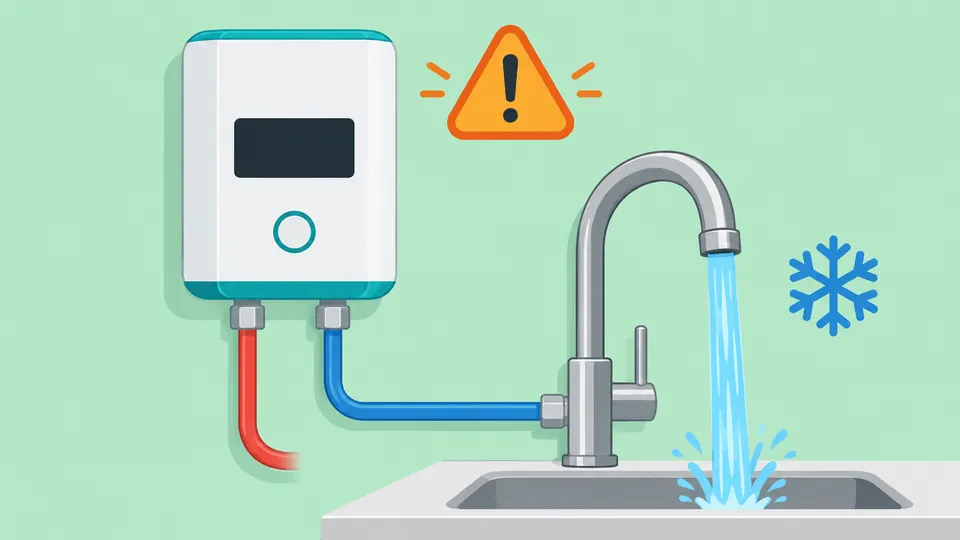
A tankless water heater with no hot water is usually short on one of four things: water flow, gas, vent airflow or power. Open a hot tap fully first, because Rinnai and Rheem units need about 0.4 gpm to fire. Then check the display for a code, make sure the gas valve is open and clean the inlet water filter. Gas, burner and vent repairs belong to a licensed technician.
On this page
- Why does a tankless water heater stop making hot water?
- Is the water flow too low for the heater to fire?
- What causes the cold water sandwich?
- What do gas and vent problems look like?
- What do the error codes mean?
- Could scale be the reason it stopped heating?
- When should you call a plumber or gas technician?
- Our Take
- Sources
Key Takeaways
- Check flow first. Rinnai and Rheem list 0.4 gpm as the flow needed to fire the burner, so a barely open tap, a clogged aerator or a dirty inlet filter can leave the water cold.
- A cold water sandwich is often a flow or timing effect. Rinnai ties it to flow below the minimum, fluctuating pressure, check valves and short on-off tap use.
- Codes differ by maker and series: code 11 means no ignition on Rinnai but a closed gas shut-off valve in Rheem's non-condensing manual. Always read your own manual.
- Owner checks stop at the gas shut-off valve, propane tank, inlet water filter, taps and the outside vent. Never adjust the gas valve or open the burner.
- If you smell gas, leave the home and call the gas supplier or fire department from outside. If a CO alarm sounds or anyone has symptoms, get outside and call 911.
Why does a tankless water heater stop making hot water?
A tankless (on-demand) gas water heater has no stored hot water to fall back on. It starts only when it senses enough water moving through it, then it needs gas, a clear vent, power and a clean water path to keep heating. If any one of those drops out, the tap runs cold.
Rinnai's own list for a unit that gives no hot water and shows no code starts with the cheap items: clean the inlet water filter, make sure the minimum activation flow is met, and make sure the hot and cold lines are not reversed or cross-connected [1]. Rheem's "not enough or no hot water" chart for its non-condensing gas models starts the same way, with the unit being on, the water shut-off valve open, and the hot tap fully open [3].
This guide covers gas tankless units, and what is true for one series may not be true for another, so check your own manual. For brand pages, see our water heater guides, Rinnai guides, Rheem guides and Navien guides.
Gas, burner and vent work inside a tankless water heater is for a licensed plumber or gas technician; the checks below stop at the gas shut-off valve, the water filter, the taps and the outside of the vent. Rinnai's code guide says only trained and qualified professionals should follow its repair steps, and warns that the internal gas valve must not be adjusted [1].
Is the water flow too low for the heater to fire?
If a tankless heater gives no hot water and shows no code, check flow first, because the burner will not light until enough water moves through the unit. Manufacturers publish the numbers:
| Maker and model family | Flow needed to fire the burner | Flow needed to keep it running |
|---|---|---|
| Rinnai N Series condensing (RU130 to RU199) | 0.4 gpm | 0.26 gpm |
| Rheem high-efficiency non-condensing gas models (RTG-style manual) | 0.4 gpm | 0.25 gpm |
Rinnai lists 0.4 gpm as the minimum activation flow and notes the true minimum may shift slightly with the temperature setting and the inlet water temperature [2]. Rheem's Use and Care manual lists a 0.4 gpm activation flow, a 0.25 gpm continuous flow and a minimum water pressure of 14 psi [3].
Those are the heater's minimums, not what you need at the tap. Rinnai tells its technicians that you should have at least 1 gpm of flow at all fixtures, and that if a fixture delivers less, you remove its flow restrictor and clean its strainer [1]. In practice that points at four owner checks:
- Open the hot tap all the way. Rinnai says that when you are not getting hot water, or the water alternates between hot and cold, the flow is often below or close to the minimum, and that raising the flow should fix it [2].
- Clean the faucet aerator and look at the shower head. Rheem lists a clogged or dirty aerator and "not enough water demand" among its causes [3]. Rinnai names low-flow shower heads, especially where groundwater is warm, and suggests removing the restrictor if the fixture allows it [1].
- Check that the water shut-off valves on the heater are fully open. Rheem lists a partly closed shut-off valve and frozen water piping among its causes, with the fix being to open the valve and let the piping thaw [3].
- Clean the inlet water filter. Rheem says to clean it monthly, and Rinnai lists a clogged inlet filter as a cause of restricted flow [3] [1]. Rinnai's steps for owners are to close the cold and hot isolation valves, put a bucket under the filter, unscrew it, rinse it, refit it and reopen the valves [2]. Rheem adds that the water heater must be turned off and unplugged first [3].
Also confirm the hot and cold lines are not reversed, which Rheem lists as a cause of no hot water [3].
What causes the cold water sandwich?
A cold water sandwich is a short blast of cold water between two stretches of hot. It is often a flow or timing problem, not a failed heater.
Rinnai's guide describes how it happens: when pressure drops in the plumbing push flow below the heater's minimum, the unit cycles on and off, and that causes the sandwich [1]. The same page lists other causes, including a clogged inlet water filter, fluctuating water pressure, and a faulty or flapping check valve.
Two of Rinnai's causes need no tools. When you cycle hot water on and off in a short period, some cold water can enter the hot plumbing during the ignition sequence [1]. And on a demand-controlled system, if the tap is not left open and is turned back on within a few minutes of the heater cycling off, a cold water sandwich is created [1].
Try opening the tap farther and leaving it running instead of pulsing it. If it keeps happening, a faulty valve diaphragm or check valve may be bleeding cold water into the hot side [1], and Rheem lists a malfunctioning mixing valve [3]. Tracing that is a plumber's job.
What do gas and vent problems look like?
Do these checks and then stop.
Gas supply. Rheem's chart says to check the gas shut-off valve and open it completely, and to contact the gas utility if gas service has been interrupted [3]. On a propane unit, Rinnai says to make sure the tank has gas, and Rheem says to refill or replace a container that is running low [3] [1]. Rinnai also notes that an undersized meter, regulator or gas line can make inlet gas pressure surge up and down and cause cycling, which only a licensed technician with a gauge can check [1].
Vent and air supply. Rheem says a blocked air intake or vent exhaust shows as codes 90 or 99 on the models in its manual, and the fix is to remove any blockage and keep 12 inches of clearance at the air intake [3]. Rinnai says its heater will not work properly if the combustion air or exhaust pipes are blocked, including by snow or ice, and that a frozen condensate line can shut a condensing unit down [2] [1]. Looking at the outside terminal and clearing snow or debris from around it is fine. Pulling apart vent pipes, the fan or the burner is not.
If you smell gas near the water heater, do not light anything or touch a switch: leave the house and call your gas supplier or the fire department from outside. Rinnai and Rheem both print the same rule: do not try to light any appliance, do not touch an electrical switch or use a phone in your building, call the gas supplier from a neighbor's phone, and call the fire department if you cannot reach the supplier [2] [3]. Gas appliances can also make carbon monoxide. The U.S. Consumer Product Safety Commission (CPSC) recommends CO alarms on every level of the home and outside sleeping areas, and says that if you suspect CO poisoning you should get outside to fresh air and call 911 [5].
What do the error codes mean?
Codes differ by maker and by series, so use the table as a map of the problem, not a repair order. Look up your own code in your manual or in our error code lookup.
| Code | Maker and manual | What the manual says | Owner action |
|---|---|---|---|
| 10 | Rinnai (N Series and others) | Air supply or exhaust blockage, or condensate trap full | Check outside vent terminal for snow or debris; call a technician for the rest |
| 11 | Rinnai | No ignition, heater not turning on | Check the gas valve is on and the propane tank has gas; then call a technician |
| 12 | Rinnai | No flame | Same gas checks; then call a technician |
| LC | Rinnai | Scale buildup in the heat exchanger; flush it | Technician flush; hard water must be treated |
| 11 | Rheem (non-condensing gas manual) | Gas shut-off valve not fully opened | Open the valve completely |
| 12 | Rheem (same manual) | Gas service interrupted, or LP gas running low | Call the gas utility, or refill the LP tank |
| P1 | Rheem (same manual) | Not enough water flow to operate the unit | Increase the flow from the fixtures |
| 90 or 99 | Rheem (same manual) | Air intake or vent exhaust may be blocked | Remove any blockage; keep 12 in. clearance |
| 1L | Rheem (same manual) | Lime deposits built up in the water heater | Contact a dealer or technician |
The Rinnai rows come from its manual's code list and technician guide [2] [1], and the Rheem rows from the service error code chart in its Use and Care manual [3]. Code 11 means different things on the two, which is why a lookup without the maker and series is unreliable.
For no-code cases on Navien, the maker's NPE-A2 FAQ says a unit with no error code that will not produce hot water most likely has a flow sensor that is not spinning properly [4]. That is a service item, not an owner repair.
Could scale be the reason it stopped heating?
Scale is a slow cause, not a sudden one, and it shows up as codes, restricted flow or an overheating unit instead of a cold tap on day one. Rinnai says scale buildup is caused by hard water and can be accelerated when the heater is set at a high temperature, and that homes with hard water may need more frequent flushing and water treatment [2]. Rheem recommends a water treatment device or softener and regular flushing of the heat exchanger, and lists scale buildup among its no-hot-water causes [3].
Rinnai says to contact a local service provider when its service reminder appears [2]. A maintenance reminder, such as Rheem's code 88 or Rinnai's SS, is a prompt to book the flush, not an error to clear without doing the work [3] [2].
When should you call a plumber or gas technician?
Call after your own checks stop at the gas valve, the filter and the taps, and the heater still has no hot water. Call sooner for any of these signs:
| Situation | Who to call |
|---|---|
| Smell of gas near the heater | Leave the house, then call the gas supplier or fire department from outside |
| CO alarm sounds, or anyone has symptoms | Get outside and call 911 |
| Code returns after one reset | Licensed plumber or gas appliance technician |
| Ignition, no flame, or fan codes with the gas valve open | Licensed gas technician |
| Scale or lime code, or hard water | Plumber, to flush and set up water treatment |
If the heater is under warranty, start with the maker's support line before anyone opens the unit.
Our Take
We think most no-hot-water calls start with flow, not a broken part. Rinnai's and Rheem's own checklists begin with an open tap, open shut-off valves, a clean aerator and a clean inlet filter, and those cost nothing. The part we would stress is where to stop: both makers say gas, burner and vent repairs are for qualified technicians, and Rinnai warns against touching the internal gas valve. A code is useful, but it is not portable. Code 11 means something different on Rinnai and on the Rheem series we read, so match the code to the maker and series. We would also treat a cold water sandwich as a clue about flow and timing before blaming the heater, and book a flush if hard water or a scale code points that way.
Sources
- Troubleshooting Tankless Water Heater Diagnostic Codes. Rinnai.
- Tankless Water Heater (Residential) Installation and Operation Manual, N Series condensing. Rinnai.
- High-Efficiency Non-Condensing Tankless Water Heater Use and Care Manual (AP22009 Rev 04). Rheem.
- Carbon Monoxide Information Center. U.S. Consumer Product Safety Commission.
Repair information is general guidance. Unplug the appliance and shut off water or gas before working on it, follow your owner's manual, and call a qualified technician for gas, refrigerant or high-voltage work. Spotted an error? Tell us.
Related Fixes
Tankless Water Heater Installation Cost: Gas, Electric and Retrofit Prices
Tankless water heater installation cost: reported price ranges, what drives them (gas, electric, venting, permits, removal) and how to decide repair or replace.
How Long Do Water Heaters Last? Lifespan by Type and Warning Signs
How long do water heaters last? See tank and tankless lifespan ranges from DOE and manufacturers, warning signs, and when to repair or replace yours.
Water Heater Replacement Cost: What You Will Pay and Why
Water heater replacement cost explained: national price ranges for tank, tankless and heat pump units, what labor, permits and venting add, and when to repair.
Water Heater Pilot Light Won't Stay Lit: Causes and When to Call a Pro
Water heater pilot light won't stay lit? See the common causes, the few safe checks, how to relight per your label, and when to call a licensed pro.
Water Heater Not Heating? Gas and Electric Checks That Find the Cause
Water heater not heating? Check the breaker, reset button, gas supply and faucets first, then see which repairs need a licensed plumber or gas technician.
Rheem Tankless Code 11: Ignition Failure Explained
Rheem tankless code 11 means the burner did not light. See what Rheem's manuals say, which gas and vent checks are safe for you, and when to call a technician.