Safety first: this problem can involve gas, refrigerant or high voltage. Use this guide to understand the issue, and have a licensed technician do any repair inside the appliance.
Tankless Water Heater Installation Cost: Gas, Electric and Retrofit Prices
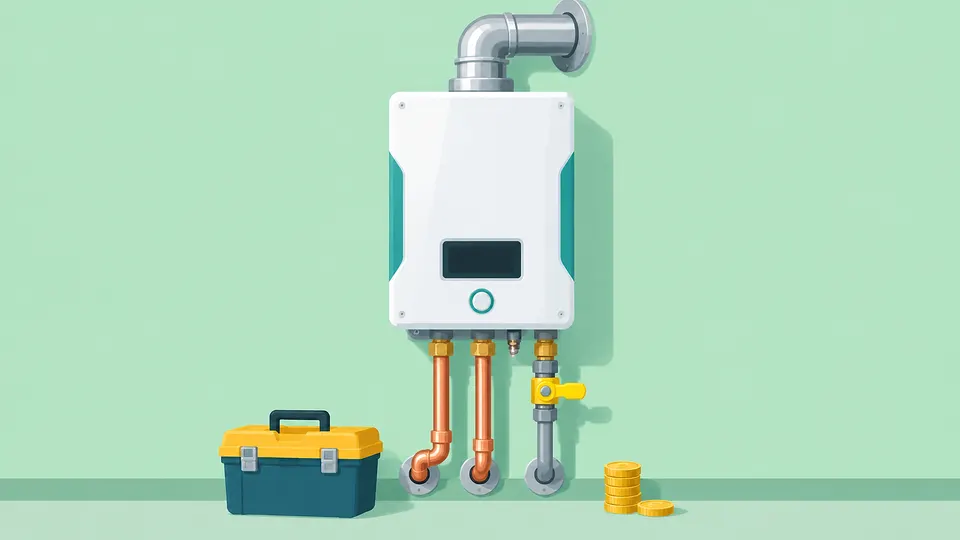
Quick Answer
Tankless water heater installation cost varies by home. One cost guide, last modified in 2023, reports a typical install of about $1,333 to $3,721. Gas units may need a bigger gas line and venting, electric units may need electrical work, and permits and old-tank removal add to the bill. Ask for an itemized written quote and check local permit rules.
On this page
- How much does tankless water heater installation cost?
- What drives the price: gas or electric, venting and permits?
- Why is swapping a tank for a tankless heater a retrofit job?
- Does a tankless water heater cost more than a tank, and does it pay back?
- What should you check before you accept a quote?
- When should you repair or replace a water heater?
- Frequently Asked Questions
- Our Take
- Sources
Key Takeaways
- Bob Vila (last modified October 2023) reports a typical tankless install at about $1,333 to $3,721; treat it as a rough frame, not a quote.
- Fuel, venting, unit size, gas line or electrical work, permits and removing the old heater move the price more than the brand.
- ENERGY STAR says certified gas demand heaters can save a family of four about $95 a year and expects a 20 year life, but the upfront cost is higher than a tank.
- Gas lines and venting are licensed-pro work, and permit and code rules vary by city, so ask your building department.
- Compare an itemized repair quote with a replacement quote when a heater is old, out of warranty or failing repeatedly.
How much does tankless water heater installation cost?
Installed prices vary a lot by house, so treat any single national "average" with caution. The one cost guide we could read in full, Bob Vila's tankless water heater cost page (last modified October 2023, citing HomeAdvisor and Angi data), puts a typical installation at about $1,333 to $3,721 [1]. That is a 2023 figure, and labor, fuel and local code rules have all moved since, so use it as a rough frame and not as a quote.
The same page breaks the job into pieces, and the pieces explain why two quotes for the "same" heater can be far apart [1]:
| Line item | Range reported | What it covers |
|---|---|---|
| Total installed | $1,333 to $3,721 | A typical whole job |
| Whole-house unit only | $450 to $1,500 | The heater itself, no labor |
| Plumber labor | $45 to $200 per hour, about $600 to $1,850 total | Installing the unit and plumbing |
| Electrician | $50 to $100 per hour, usually about 2 hours | Electrical updates |
| Gas line | Can add up to $1,000 | Running or fitting a new gas line |
| Permit | $50 to $100 | Local permit, where required |
| Old heater removal | $500 or more | Taking out and disposing of the old tank |
| Tight access | 10 to 15 percent more | Extra labor in cramped spaces |
Ask for an itemized quote, because the unit is only one line of the bill. We do not average these numbers into a single price, since they come from one dated page and each home is different.
What drives the price: gas or electric, venting and permits?
Four things move a tankless quote more than the brand name does: the fuel, the venting, the size of the unit and the permit.
Fuel. Tankless heaters come in electric, natural gas and propane versions [2]. A. O. Smith notes that gas models require proper venting and may need gas line upgrades [5]. Electric units have a different problem: Family Handyman reports that a whole-house electric unit can use more than 25,000 watts, against about 5,000 watts for a conventional water heater [7]. Bob Vila adds that an electrician is often needed for electric installs and for gas-to-electric conversions [1].
Venting. For a gas unit, how the exhaust leaves the house is a real cost. Rinnai's installer requirements list "installing venting through a wall or roof" among the skills the installer needs [4], and ENERGY STAR tells homeowners to have the installer confirm how combustion gases will be vented [3].
Size. Tankless models are rated in gallons per minute, not in tank gallons, and colder groundwater means a larger unit for the same output [2]. ENERGY STAR lists average flow of 2.5 gallons per minute for a shower, 3.3 for a clothes washer, 2.2 for a sink and 1.3 for a dishwasher [3]. A. O. Smith says larger homes may need more than one unit [5].
Permit and code. ENERGY STAR advises choosing a company that understands local residential building codes and will get a local permit "if necessary" [3]. Permit and code rules vary by city and county, so ask your building department what applies before work starts. Bob Vila reports permits at $50 to $100 where they are required [1].
Why is swapping a tank for a tankless heater a retrofit job?
A tank heater and a tankless heater need different things from the house, so a swap is more than unbolting one and hanging the other. ENERGY STAR's checklist for a gas tankless unit is a good picture of the retrofit: the installer should confirm the right gallons-per-minute size, whether the existing natural gas line is sufficient, whether electricity is near the unit for forced-ventilation models, and how combustion gases will be vented [3].
The gas line is the item homeowners most often miss. Family Handyman notes that gas burners often need a larger diameter gas pipe, which adds to the installation cost [7]. Rinnai's manual shows how that works with an example: a 180,000 BTU per hour unit plus 65,000 BTU per hour of other gas appliances needs about 245 cubic feet of gas per hour, and in its table 3/4 inch pipe at 10 feet carries 273 cubic feet per hour [4]. That is the manual's illustration only; the installer must use the table in the code that applies to your home [4].
Other retrofit items to expect on a quote:
- Power. Indoor Rinnai models need a standard grounded 120 VAC outlet or another 120 VAC source nearby [4].
- Water quality. Rinnai lists total hardness up to 200 mg/L as the limit for its heat exchanger, and says hard water must be treated or the heat exchanger flushed regularly. Damage from water quality is not covered by its warranty [4].
- Old heater removal and access. Bob Vila lists $500 or more for removing the old tank, and 10 to 15 percent more for tight spaces [1].
- Distant faucets. ENERGY STAR says a small point-of-use unit near a far fixture can help with wait time, and that continuously circulating systems should be avoided because they keep the heater firing [2].
Does a tankless water heater cost more than a tank, and does it pay back?
Yes, it costs more up front. A. O. Smith says tankless systems have higher upfront costs and a more complex installation than traditional tanks [5]. The savings are real but modest, and they depend on how much hot water you use.
- ENERGY STAR says certified gas demand heaters can save a family of four an additional $95 per year on gas bills, or $1,800 over the unit's lifetime, compared with a standard gas storage model [2].
- ENERGY STAR gives the life expectancy of demand water heaters as 20 years, much longer than conventional storage heaters [2].
- ENERGY STAR also explains why: standby time can account for 96 percent of a storage heater's daily operating time, and a tankless unit has no tank to keep hot [2].
- Bob Vila reports operating savings of about $80 to $100 per year, and running costs of about $200 per year on natural gas and about $350 on propane [1]. Family Handyman says a typical family saves about $100 or more per year, depending on water use [7].
The savings are modest next to the higher upfront cost, so the case is strongest when the old tank is already due for replacement. We do not give a payback number, because that would mean mixing figures from different sources and different years. Ask the installer to put the expected yearly saving for your home in writing.
What should you check before you accept a quote?
Gas appliances and gas lines are not a do-it-yourself job. Rinnai's manual says a licensed professional must install its water heater, and that the gas supply must be installed by a licensed professional [4]. Rheem's support page goes further: consumers should never install heating and cooling products themselves, and its warranty does not apply to equipment sold online without an in-person site visit and installation by a qualified professional [6]. Rheem also notes that many states, cities and towns require contractors to be licensed, so check your local requirements [6].
Before you sign, check these points:
- An itemized quote. Unit, venting, gas line or electrical work, permit, old heater removal and any isolation valves should each be a line.
- Permit and inspection. Ask who pulls the permit and whether an inspection is required where you live.
- Warranty terms. Rinnai's standard limited warranty lists 10 years on the heat exchanger, 5 years on other parts and 1 year of reasonable labor for residential use, and 12 years on the heat exchanger when installed with a tankless isolation valve kit [4]. The same warranty drops to 3 years if the heater is used as a circulating water heater in a loop without on-demand recirculation, and says improper installation may void it [4]. Other makers have their own terms. A. O. Smith lists 15-year warranties on some of its condensing models [5].
- Sizing. Ask how the installer chose the gallons-per-minute rating for your home. ENERGY STAR suggests an experienced plumber estimate hot water demand [3].
If you ever smell gas, do not light anything or touch a switch. Rinnai's manual says to call your gas supplier from a neighbor's phone, and to call the fire department if you cannot reach them [4].
When should you repair or replace a water heater?
The chart below is our rule of thumb for deciding, built from the sources in this guide. It is not a manufacturer procedure.
Three points make it practical:
- Check the warranty first. Rinnai's warranty says improper installation may void it, so read the terms before you pay for work [4].
- Scale is often a maintenance fix. On Rinnai units, buildup in the heat exchanger shows a code starting with LC, and the manual says to flush the heat exchanger to prevent damage [4]. If you are not sure what a code means, our error code lookup is a starting point, and our water heater guides collect the related help. Flushing and gas work are jobs for a licensed pro unless the manual says an owner can do them.
- Age matters. If your tankless unit is near the 20-year life expectancy ENERGY STAR gives [2], a costly repair is hard to justify; compare it with a replacement quote.
For more on how we choose and check our sources, see our editorial policy and about page. More practical explainers are in our guides.
Frequently Asked Questions
How long does a tankless water heater last?
ENERGY STAR gives the life expectancy of demand water heaters as 20 years, much longer than conventional storage heaters [2]. Warranties are shorter than that: Rinnai's standard limited warranty lists 10 years on the heat exchanger for residential use [4], and A. O. Smith lists 15-year warranties on some condensing models [5].
Do I need a permit to install a tankless water heater?
It depends on your city or county. ENERGY STAR advises choosing a company that understands local residential building codes and will get a local permit if necessary [3]. Bob Vila reports permits at $50 to $100 where they are required [1]. Call your local building department to confirm.
Can I install a tankless water heater myself?
We do not recommend it. Rinnai's manual says a licensed professional must install its water heater and the gas supply [4], and Rheem says consumers should never install heating and cooling products themselves [6]. Improper installation can also void the warranty.
Our Take
Our Take: we think the unit price is the least useful number in a tankless quote. The cost guides and manufacturer pages we read point to the same hidden items: the gas line, the venting, the electrical load, the permit and the old tank. We would ask for every one of those as a separate line, and we would treat a quote that lumps them together as incomplete. We would also be wary of a single national average, because the only installed range we could read in full dates from 2023. For most homes, our view is that a tankless heater makes the most sense when the old tank is already due for replacement and the house can support the gas or electric load. This is our opinion, based on the cited sources, not a test we ran, and it is not a recommendation of any installer or brand.
Sources
- Tankless Water Heater Cost. Bob Vila, 2023.
- Technical Bulletin: Demand Water Heaters. ENERGY STAR.
- Whole Home Tankless Gas Water Heaters. ENERGY STAR.
- Value Series Direct Vent Tankless Water Heater Installation and Operation Manual. Rinnai America.
- Tankless Water Heaters. A. O. Smith.
- Rheem FAQs. Rheem.
- Tankless Water Heaters: A Buyer's Guide to Heater Pros and Cons. Family Handyman, 2025.
Repair information is general guidance. Unplug the appliance and shut off water or gas before working on it, follow your owner's manual, and call a qualified technician for gas, refrigerant or high-voltage work. Spotted an error? Tell us.
Related Fixes
How Long Do Water Heaters Last? Lifespan by Type and Warning Signs
How long do water heaters last? See tank and tankless lifespan ranges from DOE and manufacturers, warning signs, and when to repair or replace yours.
Water Heater Replacement Cost: What You Will Pay and Why
Water heater replacement cost explained: national price ranges for tank, tankless and heat pump units, what labor, permits and venting add, and when to repair.
Tankless Water Heater No Hot Water: Flow, Gas, Vent and Error Code Checks
Tankless water heater giving no hot water? Check flow rate, the cold water sandwich, gas valve, vent and error codes, and see which fixes need a gas technician.
Water Heater Pilot Light Won't Stay Lit: Causes and When to Call a Pro
Water heater pilot light won't stay lit? See the common causes, the few safe checks, how to relight per your label, and when to call a licensed pro.
Water Heater Not Heating? Gas and Electric Checks That Find the Cause
Water heater not heating? Check the breaker, reset button, gas supply and faucets first, then see which repairs need a licensed plumber or gas technician.
Rheem Tankless Code 11: Ignition Failure Explained
Rheem tankless code 11 means the burner did not light. See what Rheem's manuals say, which gas and vent checks are safe for you, and when to call a technician.