Water Heater Replacement Cost: What You Will Pay and Why
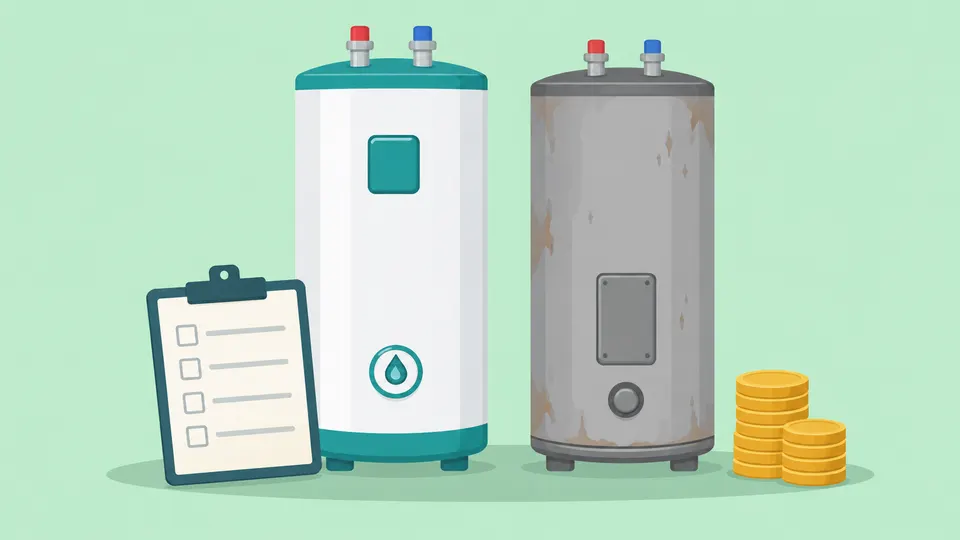
Quick Answer
A water heater replacement typically costs somewhere between about $900 and $3,000 installed, according to Fixr's January 2026 guide, though tankless and heat pump models can run higher. The price depends on tank type, fuel, venting, labor, permits and removal of the old unit. Permit and code rules vary by city, so get itemized local quotes before you decide.
On this page
- How much does it cost to replace a water heater?
- What drives the price: tank vs tankless, gas vs electric?
- What else is on the bill besides the water heater?
- Do you need a permit or a licensed plumber?
- Should you repair or replace your water heater?
- How can you keep the cost down?
- Frequently Asked Questions
- Our Take
- Sources
Key Takeaways
- Fixr's January 2026 guide gives a national installed range of $900 to $3,000; tankless and heat pump units can cost more.
- Switching fuel or adding a vent, gas line or electrical work is what turns a routine swap into an expensive job.
- Labor, permits and old-unit removal are separate cost lines, so compare itemized quotes.
- DOE says most storage heaters last 10 to 15 years and tankless more than 20; water at the tank base usually means replacement.
- Permit and licensing rules vary by city, so check locally before work starts.
How much does it cost to replace a water heater?
National guides put a typical installed price for a standard tank water heater somewhere between about $900 and $3,000, and the spread is wide for good reasons. Fixr's cost guide, updated in January 2026, lists a national range of $900 to $3,000 for a water heater installation [2]. This Old House, updated in June 2026, puts a basic tank installation at about $1,200 to $2,300 [3]. The two guides use different data, so treat both as planning ranges, not quotes.
Costs move with the type of unit you choose. The same guide shows tank-style units at $600 to $2,500 installed, tankless at $1,000 to $4,000 and heat pump or hybrid units at $1,200 to $4,600. [2]
Your own number depends on your house. Fixr notes that labor fees vary by location and usually scale with the cost of living, and that cramped crawl spaces or tight utility closets add labor [2]. This Old House reports regional swings too, from roughly 5% to 10% below the national average in the Mid-Atlantic and Midwest to as much as 45% above it in the Pacific Northwest [3]. Get at least two or three written, itemized quotes for your own address before you decide.
What drives the price: tank vs tankless, gas vs electric?
Three choices set most of the price: how the water is stored, what fuel heats it, and how the exhaust leaves the house.
| Choice | What the sources say | Price effect |
|---|---|---|
| Tank-style | Most storage water heaters last 10 to 15 years [1] | Lowest installed range in Fixr's table: $600 to $2,500 [2] |
| Tankless | Can last more than 20 years; gas tankless needs unique installation specifications [1] | $1,000 to $4,000 installed [2] |
| Heat pump or hybrid | Uses about 70% less electricity than a standard electric model, but can pose installation challenges [1] | $1,200 to $4,600 installed [2] |
| Electric | Needs no dedicated venting [2] | $500 to $3,500 installed [2] |
| Natural gas | Needs a vent; power venting adds $300 to $1,000 [2] | $700 to $2,700 installed [2] |
Tank vs tankless. A tankless unit heats water on demand instead of keeping a tank hot. The U.S. Department of Energy's Energy Saver guide (2022) says that for homes using 41 gallons or less of hot water a day, gas tankless units can be 24% to 34% more energy efficient than conventional storage tanks, and 8% to 14% more efficient for homes using around 86 gallons a day [1]. The catch is the installation. This Old House lists tankless installs at roughly 4 to 6 hours of work, against 1 to 3 hours for a tank, and itemizes gas line work of $500 to $1,000 and electrical upgrades of $300 to $800 for some tankless jobs [3].
Gas vs electric. Switching fuel types usually costs much more than swapping like for like. Fixr says a similarly sized unit on the same fuel is typically the most affordable upfront option [2], and This Old House quotes $1,500 to $2,300 for new gas lines when changing fuel [3]. Gas units also need a vent, and the type of vent matters: This Old House lists basic gas venting at $300 to $500, power venting at $300 to $600 plus $300 to $500 of electrical work, and direct venting at $500 to $1,000 [3].
Heat pump models. DOE says heat pump water heaters can be two to three times more energy efficient than conventional electric ones, and that ENERGY STAR labeled heat pump, high-efficiency gas storage, gas tankless and solar models can save up to $3,500 over a unit's lifetime [1]. DOE also says electric storage tank and electric tankless units are not ENERGY STAR eligible, because they are already highly efficient [1]. A higher price tag today can pay back through lower bills, but the savings depend on your hot water use, climate and utility rates.
What else is on the bill besides the water heater?
The unit is only part of the invoice. Labor, permits, hauling away the old tank and venting each show up as their own line or get folded into a lump sum.
Fixr lists labor at $300 to $1,500, which it says is 18% to 50% of the total, with plumbers charging $45 to $200 an hour [2]. Removing the old unit runs $75 to $500 including dump fees when billed separately [2]. This Old House gives $100 to $300 for disconnecting and disposing of the old tank [3].
New installs, such as adding a water heater where none existed, can need $400 to $1,800 of extra utility rough-in work according to Fixr [2]. A like-for-like replacement usually skips that line.
Ask each installer whether their quote includes the unit, labor, permit, removal, new fittings and any code upgrades, so you can compare quotes on the same basis.
Do you need a permit or a licensed plumber?
Rules differ by city and county, so check with your local building department before work starts. Fixr says most local building departments require permits to replace a water heater, and that in many areas the work also requires a licensed plumber [2]. It gives a permit cost range of $25 to $1,500 that varies by location, with higher fees when new gas lines, electrical work or major plumbing changes are involved [2]. This Old House gives a narrower $50 to $200 range for permits [3]. The gap shows how much local rules matter.
Permits and licensing exist because gas, venting and hot water temperature all carry real safety risks. Fixr also warns that insurance may not cover water damage from an unprofessional installation [2]. We do not recommend doing a gas or vent connection yourself, and we do not recommend any particular installer or company. Ask your city or county which permit applies, and ask any installer to confirm who pulls it.
Once the new unit is running, DOE suggests setting the temperature to 120°F, a setting it describes as safe for most of the population [1].
Should you repair or replace your water heater?
Age and where the water is coming from are the two clues that matter most. Fixr says tank heaters last 8 to 12 years and tankless models 15 to 20 years, and that units near or past those ranges are more likely to fail [2]. DOE gives longer figures, 10 to 15 years for most storage units and more than 20 for tankless [1]. Fixr also lists these replacement signs: rust-colored water or an egg-like smell that suggests internal corrosion, water pooling around the base that usually means corrosion or a cracked tank, not enough hot water, strange noises from sediment, and higher utility bills [2].
A leak from the tank itself is the clearest replace signal. A leak at a pipe fitting is a different problem that a plumber may be able to fix, so find out where the water is coming from before you decide. For a gas smell, leave the house and call your gas utility from outside. For any leak, shut off the power or gas and the water supply first.
Our rule of thumb, which is opinion and not a sourced statistic: when a unit is already in its last years, a repair buys little time, so a repair quote close to the cost of a new unit favors replacing. If you want to troubleshoot first, browse our water heater repair guides, or look up a code on your unit with the error code lookup. You can also browse the Rinnai and Rheem brand pages.
How can you keep the cost down?
You can lower the bill without cutting corners on safety.
- Match the replacement to what you have. Fixr says replacing with a similarly sized unit on the same fuel is typically the cheapest upfront route [2].
- Size the tank to the household. Fixr's guide pairs a 40-gallon tank, installed at $550 to $2,300, with 1 to 4 people, and a 50-gallon tank, $700 to $2,500, with 3 to 5 people [2].
- Compare lifetime cost, not only the sticker price. DOE notes that a new efficient water heater may cost more at first than repairing an old one or buying a less efficient model, but the energy savings continue through the life of the appliance [1]. DOE also says water heating is typically about 18% of a home's energy use [1].
- Compare itemized quotes. Use the list in the diagram above, and ask what is included. Do not choose on the headline number alone.
- Plan ahead when you can. Replacing a unit that is near the end of its life, before it floods the utility room, gives you time to compare quotes instead of paying for a rushed job. See our guides hub for other cost and lifespan articles as they are added.
Our methods are described on our editorial policy page, and you can read more about HomeFixCodes.
Frequently Asked Questions
Is it cheaper to repair or replace a water heater?
A repair is usually cheaper on the day, but it buys less when the unit is near the end of its life. DOE says most storage water heaters last 10 to 15 years. If the tank itself is leaking, replacement is usually the answer. Get a repair quote and a replacement quote and compare.
How long does a water heater replacement take?
This Old House lists about 1 to 3 hours for a standard tank job and about 4 to 6 hours for a tankless setup. Your time may differ with access, venting and any permit or inspection your city requires.
Is a gas or electric water heater cheaper to replace?
Fixr lists electric installs at $500 to $3,500 and natural gas at $700 to $2,700. The ranges overlap, so the bigger factors are venting, gas or electrical work and whether you change fuel types.
Our Take
We think the sticker price of the unit is the least useful number in this decision. In our view, the installation details decide the bill: whether you keep the same fuel, whether the vent can be reused, and what your city requires for a permit. The national ranges in this guide differ from source to source, which is a good reminder that only an itemized quote for your own house counts. We would also replace an aging tank on our own schedule, before a leak forces a rushed job, and we would not do gas or vent work ourselves. These are opinions based on the cited sources, not test results.
Sources
- Energy Saver: Tips on Saving Money and Energy in Your Home. U.S. Department of Energy, 2022.
- How Much Does It Cost to Install a Water Heater? [2026 Data]. Fixr, 2026.
- How Much Does Water Heater Installation Cost?. This Old House, 2026.
Repair information is general guidance. Unplug the appliance and shut off water or gas before working on it, follow your owner's manual, and call a qualified technician for gas, refrigerant or high-voltage work. Spotted an error? Tell us.
Related Fixes
Tankless Water Heater Installation Cost: Gas, Electric and Retrofit Prices
Tankless water heater installation cost: reported price ranges, what drives them (gas, electric, venting, permits, removal) and how to decide repair or replace.
How Long Do Water Heaters Last? Lifespan by Type and Warning Signs
How long do water heaters last? See tank and tankless lifespan ranges from DOE and manufacturers, warning signs, and when to repair or replace yours.
Tankless Water Heater No Hot Water: Flow, Gas, Vent and Error Code Checks
Tankless water heater giving no hot water? Check flow rate, the cold water sandwich, gas valve, vent and error codes, and see which fixes need a gas technician.
Water Heater Pilot Light Won't Stay Lit: Causes and When to Call a Pro
Water heater pilot light won't stay lit? See the common causes, the few safe checks, how to relight per your label, and when to call a licensed pro.
Water Heater Not Heating? Gas and Electric Checks That Find the Cause
Water heater not heating? Check the breaker, reset button, gas supply and faucets first, then see which repairs need a licensed plumber or gas technician.
Rheem Tankless Code 11: Ignition Failure Explained
Rheem tankless code 11 means the burner did not light. See what Rheem's manuals say, which gas and vent checks are safe for you, and when to call a technician.