How Long Do Water Heaters Last? Lifespan by Type and Warning Signs
Quick Answer
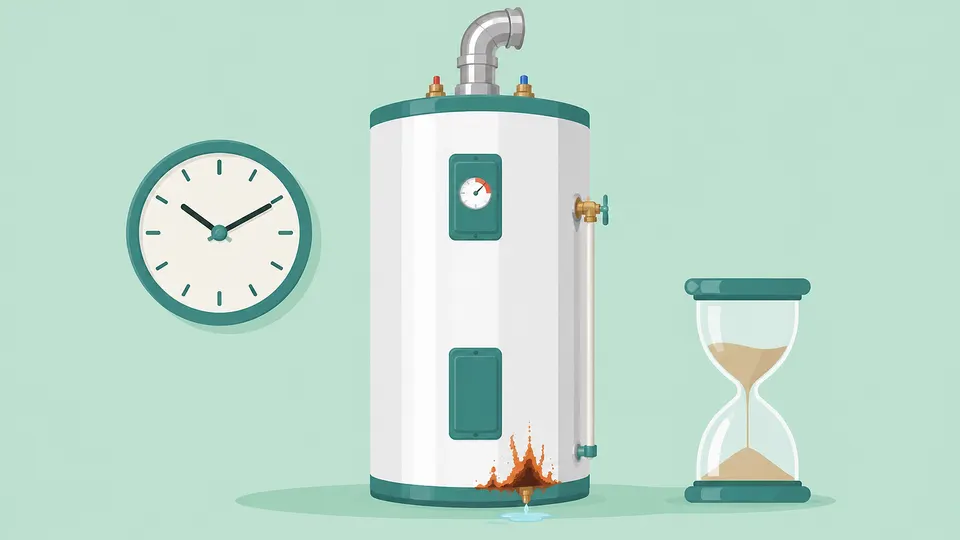
Most tank water heaters last about 8 to 15 years, depending on the source: the U.S. Department of Energy says 10 to 15, while Rheem and A. O. Smith say 8 to 12. Tankless units are generally credited with 15 to 20 years or more. Sediment, a worn anode rod, hard water and maintenance change the result. A leak from the tank usually means replacement.
On this page
- How long do water heaters last?
- What makes a water heater wear out sooner?
- What are the signs your water heater is going bad?
- Should you repair or replace a water heater?
- What does a replacement cost, and what drives the price?
- How can you make a water heater last longer?
- Frequently Asked Questions
- Our Take
- Sources
Key Takeaways
- DOE says most storage water heaters last 10 to 15 years and tankless can last more than 20; Rheem, A. O. Smith and This Old House put tanks at 8 to 12 years.
- Sediment, a used-up anode rod, hard water scale and poor installation or sizing are the main causes of early wear in the sources we read.
- Warning signs include leaks, a rusty relief valve, an anode rod with exposed core wire, heavy sediment and water that will not get hot.
- A. O. Smith says replacement makes more sense once repairs approach the cost of a new unit; get written quotes that list venting, permits and removal separately.
- If you smell gas, leave the home and call your gas utility. Gas, venting and electrical work belong to a licensed professional.
How long do water heaters last?
The U.S. Department of Energy says most storage (tank) water heaters last 10 to 15 years, while tankless water heaters can last more than 20 years [1]. Manufacturers and cost guides are a little more cautious about tanks. Rheem puts the typical tank at 8 to 12 years and tankless at 15 to 20 years or more with proper care [5]. A. O. Smith gives the same 8 to 12 and 15 to 20 year ranges [6]. This Old House says the average water heater lasts about 8 to 12 years [8].
The sources do not agree to the year, so we read them as ranges, not promises:
| Type | Range from the sources | Who says so |
|---|---|---|
| Tank (storage) | 10 to 15 years | U.S. Department of Energy [1] |
| Tank (storage) | 8 to 12 years | Rheem, A. O. Smith, This Old House [5] [6] [8] |
| Tankless | More than 20 years | U.S. Department of Energy [1] |
| Tankless | Up to 20 years | DOE Building America guideline [2] |
| Tankless | 20 years | ENERGY STAR (gas tankless) [3] |
| Tankless | 15 to 20 years or more | Rheem, A. O. Smith [5] [6] |
A tank heater that is 8 to 15 years old is in the zone where replacement should be on your radar, and a tankless unit enters that zone closer to 15 to 20 years. We found no official lifespan figure for heat pump water heaters on the pages we could read, so we do not give one here.
This Old House also notes that a unit "can last 30 years, but most fail in about 10, due mainly to neglect" [8]. Treat that as a reminder that upkeep matters, not as a number to plan around.
What makes a water heater wear out sooner?
Rheem says the answer depends on usage patterns, water quality and maintenance habits [5]. Four causes come up in the sources.
- Sediment in a tank. Rheem says sediment collects at the bottom of a tank and that periodic flushing reduces the buildup [5]. DOE's guide tells owners to drain a quart of water from the tank every 3 months to remove sediment that impedes heat transfer and lowers efficiency [1].
- A used-up anode rod. The anode rod protects the tank lining from corrosion, and Rheem says inspecting or replacing it can extend the unit's usable life [5]. A. O. Smith recommends inspecting it once a year, and says how long a rod lasts depends on water chemistry, hot water use and whether a water softener is installed [7].
- Scale in a tankless unit. Mineral scale builds up in the heat exchanger of a tankless heater, can restrict water flow and can shorten the unit's life, according to a DOE Building America guideline [2]. Rheem says annual descaling or flushing matters most in hard water areas [5].
- Installation and sizing. A. O. Smith says an undersized tankless unit wears out faster and recommends professional installation [6].
What are the signs your water heater is going bad?
No single symptom proves a heater is finished, but several together usually mean it is time to plan. The sources describe these signs.
- Leaking from the unit. This Old House lists a leaking heater, along with an ice-cold shower, as a reason to replace a unit quickly [8]. A. O. Smith says any leak around a tankless unit suggests failing seals or corroding metal [6].
- A rusty relief valve, an exposed anode core wire or heavy sediment. These are the warning signs This Old House flags in its maintenance section [8].
- Water that turns cold or never gets hot enough. A. O. Smith lists sudden cold water and trouble reaching temperature as signs of trouble [6].
- Banging, rumbling or popping. A. O. Smith lists these noises as warning signs on tankless models [6]. Tanks can make noise from sediment too, but our sources only tie the noise to tankless units, so we leave it at that.
- Repeated error codes. A. O. Smith says repeated codes can mean replacing is a better choice than another repair. If your unit shows a code, our error code lookup is a starting point for what it means [6].
- Age. A. O. Smith suggests checking the serial number or manual for the unit's age [6].
If you smell gas, leave the home and call your gas utility or emergency services; do not try to relight or repair anything. Gas lines, venting and electrical work on a water heater are jobs for a licensed plumber or technician.
Should you repair or replace a water heater?
There is no universal formula, and we will not invent one. The sources give us two practical tests. A. O. Smith says replacement makes more sense once repairs approach the cost of a new unit [6]. ENERGY STAR advises replacing an aging electric water heater before it fails [4], which is sensible for any unit whose tank is leaking, since a leaking tank cannot be patched.
Use the chart as a sorting aid, then get a written quote. If a leak is coming from a fitting, valve or pipe connection rather than the tank body, a repair may still be reasonable, and a licensed plumber can tell you which it is.
What does a replacement cost, and what drives the price?
This Old House, citing Angi, says water heater prices range from about $880 to $1,800 depending on type, size and features, as of its September 2024 update [8]. That is the price of the unit, not a full installed quote, and we do not combine it with labor figures from other sites. Tankless and solar models generally cost more up front than standard tanks [8].
Several things move the final bill:
- Tank or tankless. Tankless generally costs more up front [8], but a DOE guideline says it is generally considered to last longer [2].
- Gas or electric, and venting. DOE's guideline says a retrofit may require enlarging the gas line, and that cutting through walls or venting through a chimney with a proper flue can be cumbersome and expensive [2].
- Heat pump models. ENERGY STAR says they typically come in 50, 65 or 80 gallons, need about 700 cubic feet of surrounding air (some run with as little as 450), and need a nearby drain or condensate pump for the small amount of water they produce [4].
- Removal and disposal. This Old House says professional installation takes about one to three hours and should include removing and disposing of the old unit [8].
- Permits and code. Permit and code requirements vary by city and county, so ask your local building department what applies. We do not recommend any installer or company.
Get at least two written quotes that list the unit, labor, venting or gas work, permits and haul-away separately so you can compare them line by line.
How can you make a water heater last longer?
Maintenance will not make a 20-year-old tank young again, but the sources agree it helps.
- Drain a quart every 3 months (tank). DOE says to drain a quart of water from the tank every 3 months to remove sediment, and to follow the manufacturer's directions [1].
- Keep the temperature at 120 F. DOE advises setting the water heater to 120 F, a temperature it considers safe for most of the population [1].
- Inspect the anode rod yearly. That is A. O. Smith's recommendation [7].
- Flush a tankless unit on the manufacturer's schedule. DOE's guideline says flushing frequency ranges from twice a year to once every three years depending on the manufacturer and use [2].
- Check your warranty terms before you rely on them. Rinnai's residential SENSEI warranty covers the heat exchanger for 15 years or 12,000 operating hours, whichever comes first, and drops to 8 years if the temperature is set above 160 F [9]. A warranty is a promise about defects, not a forecast of lifespan, and other models and brands differ.
Browse our water heater guides for troubleshooting help, or the dishwasher, washer and refrigerator sections for other big appliances. To see how we pick and check sources, read our editorial policy and about page.
Frequently Asked Questions
How long does a tankless water heater last?
DOE's Energy Saver guide says tankless water heaters can last more than 20 years [1]. Rheem and A. O. Smith give 15 to 20 years or more with proper care [5] [6]. Descaling matters most in hard water areas [5].
How can I tell how old my water heater is?
A. O. Smith suggests checking the serial number or the manual [6]. The label on the unit and the manufacturer's support line can usually decode the serial number into a date, but formats differ by brand.
Is a long warranty the same as a long lifespan?
No. A warranty covers defects for a set period and has conditions. For example, Rinnai's SENSEI residential warranty covers the heat exchanger for 15 years or 12,000 operating hours, whichever comes first, and drops to 8 years if the temperature setting exceeds 160 F [9]. Read the warranty for your model.
Our Take
Our Take: we think the most useful number is not one lifespan but a range, and a decision date. The sources disagree by a few years on tanks, so we would start watching a tank heater closely around 8 to 10 years and plan its replacement before it leaks, because a failed tank can damage a home. We would not pay for a large repair on an old tank when the quote is close to the price of a new unit, which is the test A. O. Smith gives. For tankless units, we would treat descaling on the manufacturer's schedule as the single habit most likely to protect the unit. We would also ask for itemized quotes and check local permit rules. This is our opinion, based on the cited sources, not a test we ran.
Sources
- Energy Saver: Tips on Saving Money and Energy in Your Home. U.S. Department of Energy, 2022.
- Measure Guideline: Transitioning to a Tankless Water Heater. U.S. Department of Energy, Building America (IBACOS), 2012.
- Save More with ENERGY STAR Gas Tankless Water Heaters. ENERGY STAR.
- Hot Water Heater Replacement Guide (heat pump water heaters). ENERGY STAR.
- Tank vs. Tankless Water Heater Lifespan Comparison: What to Expect Long-Term. Rheem Manufacturing Company.
- How Long Do Water Heaters Last?. A. O. Smith.
- Water Heater Maintenance. A. O. Smith.
- Hot Water Heater Buying Guide. This Old House, 2024.
- Limited Warranty: SENSEI Residential Tankless Water Heaters. Rinnai America Corporation, 2024.
Repair information is general guidance. Unplug the appliance and shut off water or gas before working on it, follow your owner's manual, and call a qualified technician for gas, refrigerant or high-voltage work. Spotted an error? Tell us.
Related Fixes
Tankless Water Heater Installation Cost: Gas, Electric and Retrofit Prices
Tankless water heater installation cost: reported price ranges, what drives them (gas, electric, venting, permits, removal) and how to decide repair or replace.
Water Heater Replacement Cost: What You Will Pay and Why
Water heater replacement cost explained: national price ranges for tank, tankless and heat pump units, what labor, permits and venting add, and when to repair.
Tankless Water Heater No Hot Water: Flow, Gas, Vent and Error Code Checks
Tankless water heater giving no hot water? Check flow rate, the cold water sandwich, gas valve, vent and error codes, and see which fixes need a gas technician.
Water Heater Pilot Light Won't Stay Lit: Causes and When to Call a Pro
Water heater pilot light won't stay lit? See the common causes, the few safe checks, how to relight per your label, and when to call a licensed pro.
Water Heater Not Heating? Gas and Electric Checks That Find the Cause
Water heater not heating? Check the breaker, reset button, gas supply and faucets first, then see which repairs need a licensed plumber or gas technician.
Rheem Tankless Code 11: Ignition Failure Explained
Rheem tankless code 11 means the burner did not light. See what Rheem's manuals say, which gas and vent checks are safe for you, and when to call a technician.