Prefer a technician? Find a Rinnai PRO(official Rinnai site)
Rinnai Code 10: Blocked Vent or Air Supply, What It Means
Quick Answer
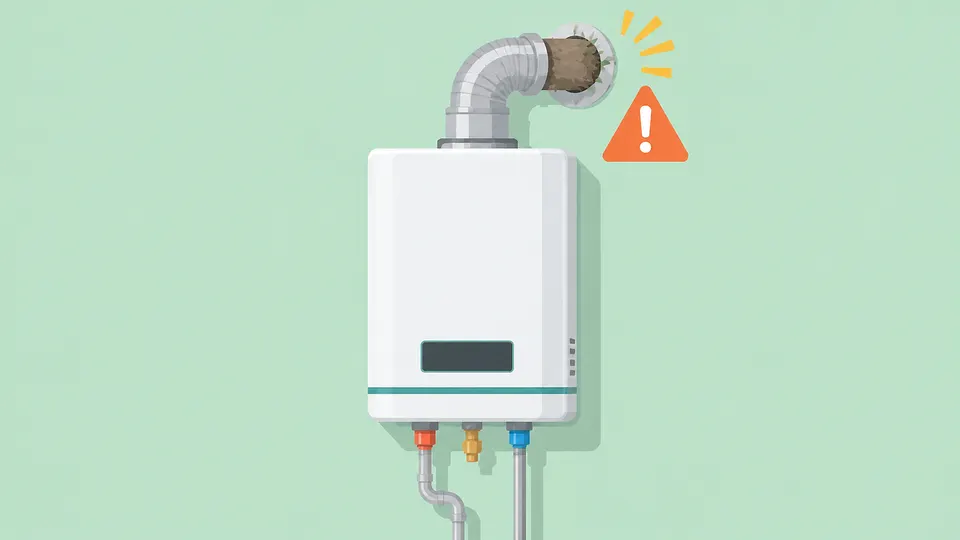
Rinnai code 10 means the tankless water heater has detected a problem with its air supply or exhaust, such as a blocked vent, a dirty intake filter or a clogged condensate line, and has stopped heating. Check that the vent ends outside are clear, clean the air filter on indoor models and make sure the condensate line drains. If the code returns, call a licensed technician.
On this page
Key Takeaways
- Rinnai lists code 10 as an air supply or exhaust blockage; the N Series manual adds that a full condensate trap can cause it too.
- Causes run along the air path: vent ends, air filter, fan and check valve, heat exchanger fins, exhaust joints and the condensate line.
- Safe owner checks are the vent ends from the ground, the condensate line and, on indoor models, the air filter. Gas parts, burners and sensors are for a licensed technician.
- Do not keep running a unit that has shut down on code 10. If you smell gas, leave and call from outside; if a CO alarm sounds, get outside and call 911.
What does Rinnai code 10 mean?
Code 10 is Rinnai's air supply or exhaust blockage code. Rinnai's diagnostic guide for tankless water heaters lists it for both its SENSEI and non-SENSEI series and ties it to the vent system, the intake air filter and the condensate line [1]. Rinnai's manual for the N Series condensing models (RU130 to RU199, indoor and outdoor) words it a little differently: "Air Supply or Exhaust Blockage / Condensate Trap is Full" [2]. The Value Series manual (V65i to V94e) uses the shorter "Air Supply or Exhaust Blockage" [3].
In plain terms, the water heater needs fresh air going in and exhaust gas going out. When something restricts either path, or when water backs up into the condensate trap, the unit stops heating and shows 10. Code 10 is a safety shutdown, so treat it as a warning rather than a nuisance code.
This article covers Rinnai tankless models, one of the brands in our water heater guides and on the Rinnai brand page. The code is listed across those series, but the checks differ by model: the N Series manual marks the air filter and vent checks as indoor-water-heater items [2]. Look at the label on your unit and the manual for that exact model before you follow any step here.
Code 10 is not the same as the neighboring codes. Rinnai lists 11 as no ignition and 12 as no flame, and both point to gas supply, igniter and flame rod checks [2]. Code 10 is also close to code 05: Rinnai says fin build-up can lead to either one [1]. If you are not sure which code you have, our error code lookup can help you narrow it down.
What causes Rinnai code 10?
Every cause on Rinnai's list sits somewhere along the air path, from the intake vent to the exhaust vent, plus the condensate drain.
| Cause | What Rinnai says | Who checks it |
|---|---|---|
| Clogged or frozen condensate line | It backs up into the condensate trap and shuts the heater off to prevent spillage, setting code 10 [1] | You can look; a pro fixes anything inside |
| Dirty intake air filter (indoor models) | Clean the inlet air filter at the top right of the cabinet [1] | You, following the manual |
| Blocked, damaged or poorly assembled vent | Check clearances, vent materials, seating of each section and debris such as water, condensation or insects [1] | Pro for anything beyond the outside vent ends |
| Vent run too long | The vent must stay within the allowable equivalent length [1] | Installer or pro |
| Collapsed pipe at the wall | Foam sealant around the pipe penetration can collapse the vent pipe [1] | Pro |
| Fan, check valve or circuit board | A restricted fan, a stuck check valve, a defective fan motor, harness or PC board can all cause it [1] | Pro |
| Build-up on the heat exchanger fins | Blockage between the fins restricts airflow and leads to code 05 or 10 [1] | Pro |
| Altitude setting | Rinnai asks technicians to verify the high altitude parameter for the site [1] | Pro |
A bad vent joint can cause more than the code: Rinnai warns that skipping the vent supplier's lubricant when assembling vent sections can lead to "exhaust gas leakage and a code 10" [1]. The condensate cause is easy to miss because the vent can be clear while the drain line is frozen, so in cold weather check it first.
What can you check yourself?
Rinnai's own manuals open the code 10 remedies with checks that do not involve gas parts. Stay with those. Do not open the gas valve inside the unit, remove the burner, adjust gas pressure or bypass any sensor. Those jobs belong to a licensed gas technician.
- Smell and listen first. If you smell gas, leave the home and call your gas supplier from outside. Rinnai's manual says not to light any appliance, not to touch any electrical switch and not to use any phone in the building, and to call the gas supplier from a neighbor's phone, or the fire department if the supplier cannot be reached [2].
- Look at the vent ends from the ground. The Value Series remedy for code 10 starts with checking that nothing is blocking the flue inlet or exhaust [3]. Look for leaves, nests, ice or snow, but do not climb a ladder or onto a roof, and do not poke tools into the pipe.
- Check the condensate line. Rinnai says to confirm that it drains properly, because a clogged or frozen line backs up into the trap and triggers the code [1]. If the pipe is frozen, a plumber can thaw it safely; do not use a flame or heat gun on plastic pipe.
- Clean the air filter on indoor models. Rinnai's N Series manual describes this as routine maintenance for indoor units: press On/Off so the display goes blank, remove the four screws holding the front panel, pull the filter out by the "FILTER Pull to Clean" tab, scrub it with mild dish soap and a soft brush, rinse, dry it with a lint-free towel, check it for debris, refit it and power the unit back on [2]. The same manual says not to run the water heater without the air filter in place [2]. If you are not comfortable removing the front panel, have a technician do this step.
- Test once. Open a hot tap. If the code does not return, you probably found the cause. If it comes back, stop and call a pro. Rinnai's list does not give a reset as the fix for code 10, and in our reading repeated restarting only delays the repair.
The vent-length graphic above is background for the next section, not something to measure at home. It shows Rinnai's own example, where concentric venting with two 90-degree elbows, two 45-degree elbows and 10 feet of straight pipe works out to 28 equivalent feet, with each 90-degree elbow counting as 6 feet and each 45-degree elbow as 3 feet [1]. The allowed total depends on your model and vent system, so the installer or technician has to compare it with your manual.
What will a technician check?
If the quick checks do not clear code 10, the next steps in Rinnai's guide call for tools, training or both. Rinnai's manuals warn that some checks should be performed only by a trained and qualified professional, and that consumers should never attempt an action they are not qualified to perform. [2]
| Technician step | Why it matters |
|---|---|
| Inspect the whole intake and exhaust run | Poor seating, wrong materials or a collapsed section restrict airflow [1] |
| Mark and take apart vent joints | Shows whether each joint has the correct insertion depth [1] |
| Compare vent length and termination clearances with the manual | An over-long run or poorly placed terminal can cause the code [1] |
| Remove the fan motor and inspect the fan, housing and check valve | A restriction or stuck check valve limits airflow [1] |
| Inspect the burner and heat exchanger | Debris or build-up between fins restricts airflow [1] |
Rinnai also puts a hard line around one test. Its guide describes removing the exhaust section to see whether the unit runs without the vent, but only as a quick on-site test, and it warns never to leave a water heater operating with the vent piping disconnected [1]. That is why we do not describe it as a homeowner step.
Our editorial policy explains why we send gas work to licensed pros.
Is it safe to keep using the water heater with code 10?
No. The unit has shut down for a reason, and the sensible choice is to leave it off until the cause is found. Rinnai links vent problems to exhaust gas leakage [1], and exhaust gas from a gas appliance can contain carbon monoxide.
The Consumer Product Safety Commission says to install battery-operated CO alarms, or alarms with battery backup, on every level of the home and outside sleeping areas [4]. If a CO alarm sounds or you suspect carbon monoxide poisoning, get outside to fresh air immediately and call 911. CPSC lists head pain, dizziness, weakness, queasiness, vomiting, drowsiness and confusion as symptoms [4].
Use these rules as a guide:
- Gas smell: leave, then call the gas supplier from outside or a neighbor's phone [2].
- CO alarm or symptoms: get outside and call 911 [4].
- Code 10 only, no smell and no alarm: leave the unit off, do the safe checks above, then call a licensed plumber or gas technician if it returns.
A cold shower is an annoyance. A blocked exhaust is a safety problem, so heat water on the stove for washing rather than working around the shutdown.
How can you stop code 10 from coming back?
Most prevention is simple and comes from Rinnai's own maintenance advice. Inspect the air filter on indoor models periodically, and clean it if it has lint or dust build-up [2]. If the filter looks damaged, Rinnai says to contact a trained and qualified professional for a replacement filter assembly [2].
For the outside vent ends, a quick look from the ground after storms, leaf fall and snow costs nothing. Much like clearing lint from a dryer vent, keeping the air path open is the whole job. Keep plants, stored items and snow banks away from the terminations, since Rinnai's guide asks technicians to verify clearances from overhangs, grades, obstructions, walls and porches [1].
Watch the condensate line in winter, since a frozen line is on Rinnai's list of causes.
We built this guide from Rinnai's own documents; about us explains how we choose and cite sources.
Frequently Asked Questions
Is Rinnai code 10 the same as an air supply or exhaust blockage?
Yes. Rinnai's manuals label code 10 as "Air Supply or Exhaust Blockage". The N Series manual adds "Condensate Trap is Full" to the label, so a clogged or frozen condensate line can trigger it as well.
Can I reset code 10 and keep using the water heater?
Rinnai's code 10 remedies do not list a reset as the fix. The code points to a restricted air path, so the cause has to be found. Leave the unit off after it shuts down, do the safe checks, and call a licensed technician if code 10 comes back.
Do outdoor Rinnai models show code 10 too?
The code exists across Rinnai tankless series, but the N Series manual marks the air filter and vent checks as indoor-model items. Follow the manual for your exact model.
What should I do if I smell gas with code 10 showing?
Do not try to light any appliance, touch electrical switches or use a phone in the building. Leave the home and call your gas supplier from outside or a neighbor's phone, as Rinnai's manual instructs. Call the fire department if you cannot reach the supplier.
Our Take
Our Take: code 10 looks like a plain blockage message, but in our view the vent and exhaust side is why it deserves respect. Rinnai's own guide links bad vent joints to exhaust gas leakage, so we would not treat it like a nuisance error. The owner steps in Rinnai's manuals are modest: look at the vent ends, check the condensate line and clean the air filter. We would stop there and call a licensed gas technician if the code returns, rather than open the cabinet or restart the unit repeatedly. If you have a carbon monoxide alarm, test it today; it is the cheapest safeguard on the page.
Sources
- Troubleshooting Tankless Water Heater Diagnostic Codes (document 100000652). Rinnai America Corporation.
- Tankless Water Heater (Residential) Installation and Operation Manual, N Series Condensing (RU130-RU199, indoor and outdoor). Rinnai America Corporation.
- Direct Vent Tankless Water Heater Installation and Operation Manual, Value Series (V65i-V94e). Rinnai America Corporation.
- Carbon Monoxide Information Center. U.S. Consumer Product Safety Commission, n.d..
Repair information is general guidance. Unplug the appliance and shut off water or gas before working on it, follow your owner's manual, and call a qualified technician for gas, refrigerant or high-voltage work. Spotted an error? Tell us.
Related Fixes
Dryer Not Heating? Gas vs Electric Troubleshooting
Dryer not heating? Check the cycle, both breakers on an electric dryer, the gas shutoff valve on a gas dryer, then the vent. See which parts need a technician.
Tankless Water Heater Installation Cost: Gas, Electric and Retrofit Prices
Tankless water heater installation cost: reported price ranges, what drives them (gas, electric, venting, permits, removal) and how to decide repair or replace.
How Long Do Water Heaters Last? Lifespan by Type and Warning Signs
How long do water heaters last? See tank and tankless lifespan ranges from DOE and manufacturers, warning signs, and when to repair or replace yours.
Water Heater Replacement Cost: What You Will Pay and Why
Water heater replacement cost explained: national price ranges for tank, tankless and heat pump units, what labor, permits and venting add, and when to repair.
Tankless Water Heater No Hot Water: Flow, Gas, Vent and Error Code Checks
Tankless water heater giving no hot water? Check flow rate, the cold water sandwich, gas valve, vent and error codes, and see which fixes need a gas technician.
Water Heater Pilot Light Won't Stay Lit: Causes and When to Call a Pro
Water heater pilot light won't stay lit? See the common causes, the few safe checks, how to relight per your label, and when to call a licensed pro.