Dishwasher Not Cleaning? Fixes by Symptom

Quick Answer
Start with what is left on the dishes. Gritty film usually means a clogged filter; food on the top rack points to a blocked middle spray arm; cloudy glass is hard water if vinegar removes it and etching if it does not. Turn off power, clean the filter and spray arms, confirm the water reaches 120 to 149°F, use fresh detergent with rinse aid, and load with dirty sides facing the arms.
On this page
Key Takeaways
- Read the residue first: grit points to the filter, top-rack food to the middle spray arm, and white film to water hardness or detergent.
- Turn off power at the breaker, then clean the filter and clear the spray arm holes. These two steps cost nothing.
- Samsung says the water heater should deliver 120 to 149°F; Whirlpool says the dishwasher needs 20 to 120 psi and a fully open supply valve.
- Use fresh tablets or packs with rinse aid, never hand dish soap, and scrape plates instead of rinsing them.
- Cloudy glass that vinegar will not clear is etching, which is permanent. Less detergent and water that is not over-softened prevent more of it.
Why is my dishwasher not cleaning dishes?
Look at what is left on the dishes before you change anything: grit, stuck food and cloudy film each point to a different part. A dirty dishwasher rarely has a single cause. Whirlpool's list for dishes that come out dirty runs from a partly closed water valve and low water pressure to overloading, the wrong detergent and hard water [1]. Samsung adds water temperature, detergent that never left the dispenser and pre-rinsing [6].
Match your symptom to a row, then go to the fix.
| What you see after the cycle | Most likely cause | First thing to try |
|---|---|---|
| Gritty or sandy film, small food specks | Clogged filter sending food back onto dishes | Clean the filter and sump |
| Food stuck on dishes in both racks | Water valve not fully open, low pressure, cool water, wrong cycle | Open the valve, run the hot tap, pick a heavier cycle |
| Food left on the top rack only | Middle spray arm blocked or clogged | Spin the arm by hand, clear its holes, reload |
| Bottom rack dirty, top rack clean | Top Rack Only cycle selected | Choose a full cycle |
| Detergent still in the cup or a lump of pod | Dispenser blocked or detergent not dissolving | Fix the dispenser before anything else |
| White film that wipes off with vinegar | Hard water or detergent residue | Rinse aid, monthly cleaner, softener |
| Cloudy glass that will not wipe clean | Etching (permanent) | Use less detergent, stop pre-rinsing |
| Suds in the tub | Hand dish soap was used | Stop the cycle and let the suds settle |
The rows come from the troubleshooting pages of Whirlpool [2] and Samsung [6], and each one is explained below. If water stays in the tub after the cycle, that is a different problem; see our guide to a dishwasher that won't drain.
How do you fix a dishwasher that leaves dishes dirty?
Work from the free checks to the slower ones. Most of these take a few minutes and no tools.
Step 1: Turn off the power and clean the filter
Turn off power at the circuit breaker before you remove the filter or a spray arm. KitchenAid gives cutting power at the breaker as the first step before reaching into the tub [10].
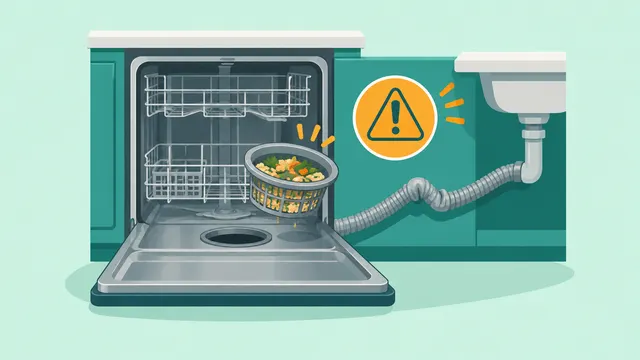
The filter is the most common source of a gritty film. KitchenAid says a clean filter keeps the water flowing strong and stops food particles from recirculating during the cycle. On its removable filters you turn the upper assembly a quarter turn counterclockwise, lift it out, pull it apart and rinse it under running water, using a soft brush for stubborn soil or hard-water deposits. Some models use a maintenance-free filter with a foreign object cup that you empty instead [9]. Samsung says to take the filter apart and clean each piece with warm, soapy water [7]. Reseat it until it locks.
Step 2: Clear the spray arms
Food and minerals block the small holes in the arms. Samsung suggests a thin, pointed object such as a needle or toothpick to clear each hole [7]. Whirlpool says hard-water mineral buildup can collect on the spray arms, and that a blocked arm delays detergent release and soil removal, which can leave residue through the final rinse [4].
Step 3: Check the water: valve, heat and pressure
Whirlpool says the water supply valve must be completely open for the dishwasher to wash and rinse properly, and that the dishwasher needs 20 to 120 psi (138 to 828 kPa) to fill [1]. Samsung says the water heater should deliver 120 to 149°F [6]. Run the kitchen tap before you start a cycle: Samsung's advice is that if hot water takes more than a few seconds, or a minute, to arrive, check the water heater, and call a plumber if the setting is right but the water still is not hot [7].
Step 4: Fix the detergent and add rinse aid
If detergent is still in the dispenser after a cycle, Samsung says to solve that dispensing or dissolving problem first [6]. Whirlpool recommends pre-measured tablets or packs, says they clean better than powder, liquid or gel, and says to add detergent just before the cycle and store it tightly closed in a cool, dry place. Never use hand dish soap: Whirlpool says its suds can push water out of the dishwasher and reduce wash performance [1].
Samsung says its dishwashers run without rinse aid but clean better with it, because rinse aid reduces hard-water film. It also warns that too much or too little detergent can leave a white film [6].
Step 5: Load for the spray, and pick the right cycle
Whirlpool says to avoid overloading, to angle soiled surfaces down and inward toward the spray arms, and to keep plastic cups, bowls and mugs off the lower rack [2]. Scrape plates, but do not rinse them: Samsung says pre-rinsing can etch dishes and leave a white film [6], and ENERGY STAR says rinsing before loading only adds water and energy use [11]. Use a heavy cycle for pots, pans and casseroles.
Step 6: Clean the dishwasher once a month
Buildup inside the machine causes filming and spotting. Whirlpool says to clean the dishwasher about every 30 days with a dishwasher cleaner [2]. Samsung suggests a cup of distilled white vinegar on the upper rack with a hot cycle about once a month, or the Self Clean cycle without detergent [6]. If the problem is a smell rather than dirty dishes, our dishwasher smells guide covers the door seal and drain too.
Why is the top rack of my dishwasher not getting clean?
When only the top rack comes out dirty, check the spray arm under it before anything else. Whirlpool's test is quick: before you start a cycle, spin the middle spray arm by hand, and if it resists, rearrange the dishes [3]. Samsung describes the same failure from the other side: when a dish touches the arm, the arm cannot rotate [8].
If the arm spins freely, take it off if your manual allows and clear its holes with a toothpick. Top-rack glasses also need the right angle. Whirlpool says glassware should face down and inward toward the spray arms, with space between items so water and detergent reach every surface [3].
The opposite pattern has a simple cause. Whirlpool notes that the Top Rack Only cycle is meant for small loads, so the lower spray arm does not run and the bottom rack will not get clean [4].
What is the white film or cloudy residue on dishes?
There are two kinds of white film, and they need opposite fixes. Rub a cloudy spot with a little white vinegar. Whirlpool says hard-water and detergent film can often be removed, while film that does not come off may be etching or silica film, and etching cannot be reversed [5].
Film that comes off is mineral or detergent residue. Whirlpool says water at 15 grains per gallon or more can damage the dishwasher and make good results hard, and recommends a water softener [1]. Rinse aid and a monthly cleaning cycle help too.
Film that stays is etching. Whirlpool links it to very soft water combined with strong detergent, too much powder or liquid detergent, and long or hot cycles, and says etched glassware may need to be replaced [5]. Samsung says to keep softened water no softer than 7 grains per gallon [6]. So the softener that cures hard-water film can cause etching if it is set too soft.
When should you call for service?
If you have cleaned the filter and arms, confirmed hot water and pressure, fixed the detergent and loading, and run a cleaning cycle, and the dishes are still dirty, contact the manufacturer. Samsung and Whirlpool both send owners to service at that point [6] [4]. A spray arm that will not turn when nothing blocks it, or a dishwasher that never seems to fill or heat, is a parts problem for a technician, not a cleaning problem.
Watch for these signs as well:
- A code on the display. Look it up in our error code lookup. Leak codes such as Samsung LC and LG AE stop the wash, and a drain code such as Bosch E24 leaves dirty water behind.
- Dirty water in the sink or disposal. If the dishwasher drains into a disposal that is jammed, see our garbage disposal guide.
- A burning smell, damaged wiring or a tripping breaker. KitchenAid says to call a technician right away [10]. Do not open the control or toe panel yourself.
Find more dishwasher guides on our dishwashers page.
Frequently Asked Questions
Should you rinse dishes before putting them in the dishwasher?
No. Scrape off large food, then load. Samsung says pre-rinsing can etch dishes and leave a white film, and ENERGY STAR says rinsing before loading only adds to the water and energy used.
How often should you clean the dishwasher filter?
KitchenAid's filter care page gives a routine of about every 30 days, and Whirlpool suggests cleaning the whole dishwasher on the same schedule. Clean the filter sooner if you see grit on dishes. Some models have a maintenance-free filter with a foreign object cup that you empty when it fills; your manual shows which kind you have.
Can you use regular dish soap in a dishwasher?
No. Use automatic dishwasher detergent only. Whirlpool says hand dish soap makes suds that can push water out of the dishwasher and reduce wash performance. If suds appear, turn the dishwasher off and let them settle.
Our Take
We think most dishwashers that stop cleaning are not broken; they are clogged, starved of hot water, or fed the wrong detergent. Whirlpool and Samsung list the same basics before they ever mention service, and the filter plus spray arm check takes about as long as a cycle. In our view the most useful habit is reading the residue: grit, stuck food and cloudy film send you to different parts, so you stop guessing. We would also be careful with water softeners. They fix hard-water film, but Samsung warns against going below 7 grains per gallon and Whirlpool ties very soft water to etching, which no cleaner can undo. If the basics are covered and dishes stay dirty, we would call the manufacturer.
Sources
- Dishes are not Clean. Whirlpool.
- Food Residue Remains on Dishes. Whirlpool.
- Food Residue on Glassware. Whirlpool.
- Spray Arm Not Working - Dishwasher. Whirlpool.
- Etching or Cloudy Glassware. Whirlpool.
- Dishwasher cycle ends before dishes are clean. Samsung Electronics America.
- Samsung Dishwasher stinks or has a musty smell. Samsung Electronics America.
- Samsung Dishwasher is Not Cleaning Well. Samsung Electronics Australia.
- How to Clean the Dishwasher Filters. KitchenAid.
- Dishwasher Not Draining. KitchenAid.
- Dishwashers. ENERGY STAR (U.S. EPA).
Repair information is general guidance. Unplug the appliance and shut off water or gas before working on it, follow your owner's manual, and call a qualified technician for gas, refrigerant or high-voltage work. Spotted an error? Tell us.
Related Fixes
Dishwasher Not Draining? How to Find and Fix the Cause
Dishwasher not draining? Clean the filter, then check the sink, disposal knockout plug, drain hose and air gap. Brand drain codes and when to call service.
Why Does My Dishwasher Smell? How to Get Rid of It
Why does your dishwasher smell? Match the odor to its cause, clean the filter, spray arms and door seal, check the drain, and know when a smell means service.
Samsung Dishwasher LC Code: Finding the Leak
Samsung dishwasher LC or LE means the leak sensor found water in the base. Cut power and water, find the leak, let it dry, and know when to call for service.
LG Dishwasher AE Code: Leak Sensor Fixes
LG dishwasher AE code means water reached the base pan and tripped the leak float. Fix suds, level the unit, clean the door gasket, dry the pan, then retest.
Bosch Dishwasher E24 Error: Clearing the Drain
Bosch dishwasher E24 means water is not draining. Clean the filter, check the pump cover, hose, air gap and disposal plug, then reset. Call Bosch if it returns.