Dishwasher Not Draining? How to Find and Fix the Cause
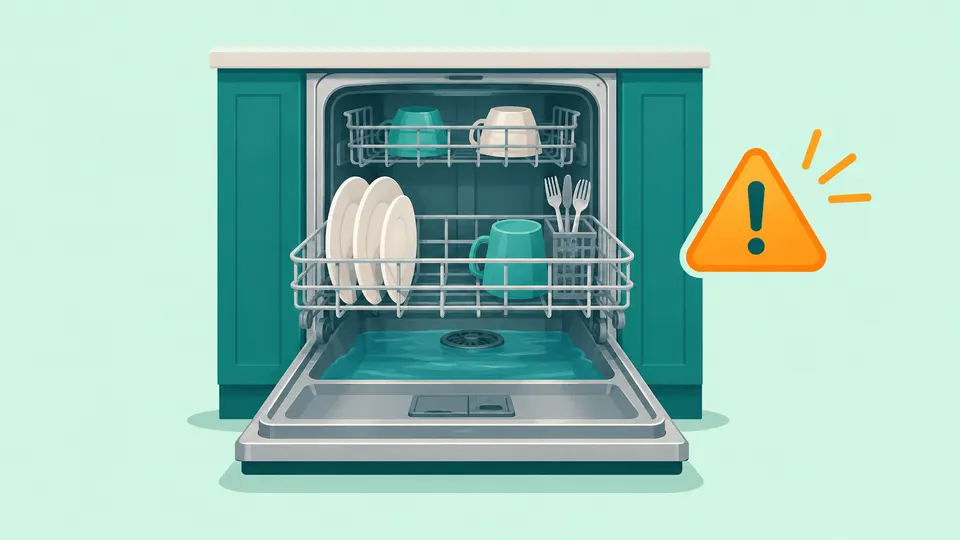
Quick Answer
A dishwasher that won't drain is usually blocked somewhere between its filter and your sink drain. KitchenAid points to a clogged filter, a kinked or pinched drain hose, a disposal knockout plug that was never removed, a blocked air gap or a clogged sink drain, and Samsung adds a clogged garbage disposal. Cut power at the breaker, clean the filter first, then work outward along the drain path. If it still won't drain, book service.
On this page
- Why is my dishwasher not draining?
- Is a little water in the bottom of a dishwasher normal?
- What should you do before you start?
- How do you fix a dishwasher that won't drain?
- What do dishwasher drain error codes mean?
- When should you call a technician or a plumber?
- Frequently Asked Questions
- Our Take
- Sources
Key Takeaways
- Most of the checks are blockages an owner can reach: the filter, the sink drain, the disposal, the drain hose and the air gap.
- A little water below the filter is normal on some models; water pooling above the filter after a cycle is not.
- Turn off power at the circuit breaker and shut off the water supply before you reach into the tub or under the sink.
- Brand drain codes include LG OE, Samsung 5C or 5E, Whirlpool F9 E1 and Bosch E24, and they share similar first checks.
- Never pour drain-opening chemicals into a dishwasher, and call a technician if the pump hums but water does not move.
Why is my dishwasher not draining?
Water leaves a dishwasher through a short chain of parts: the filter and sump at the bottom of the tub, the drain pump, the drain hose, an air gap or high loop under the counter, and finally the garbage disposal or sink drain. A clog or kink at any point in that chain stops the water. KitchenAid's guide lists a clogged filter, a kinked or crushed hose, a blocked air gap, a disposal knockout plug that was never removed, a downstream sink clog and a jammed drain pump among the causes [1].
| Cause | What you may notice | First fix |
|---|---|---|
| Clogged filter or sump | Food, labels or glass bits around the filter; water sits above it | Remove and rinse the filter, clear the sump |
| Kinked, pinched or sagging hose | Dishwasher recently installed or pushed back; hose crushed under the cabinet | Straighten the hose and secure a high loop |
| Garbage disposal clog or knockout plug | Disposal newly installed, or full of food waste | Clear the disposal; remove the knockout plug on a new install |
| Clogged air gap | Water may spill from the small cap beside the faucet | Remove the cap and clear debris |
| Slow sink drain | Sink also drains slowly | Clear the sink trap or call a plumber |
| Jammed drain pump | Steady hum with no water movement | Call a technician |
| Control or wiring fault | Cycle pauses and the pump never starts | Call a technician |
New installation. Samsung says the most common reason for a drain problem right after installation is a dishwasher sitting on its own drain hose and pinching it shut [2]. Another install mistake to check is a garbage disposal knockout plug that was never removed (Step 3 below).
Is a little water in the bottom of a dishwasher normal?
On some models, yes. LG says water sitting below the level of the filter is normal, because it keeps sewer smells from coming back into the tub. Water that keeps pooling above the filter is the problem [4]. KitchenAid adds that water slightly above the filter screen often points to a partial restriction in the filter, sump or hose [1].
Before you start taking parts out, make sure the cycle actually finished. A paused or interrupted cycle can leave water in the tub that drains when the cycle is completed.
What should you do before you start?
Turn off power to the dishwasher at the circuit breaker, not only at the control panel, and shut off the dishwasher's water supply valve under the sink. KitchenAid gives both steps as the first part of its drain guide [1]. LG also says to turn off the shut-off valve before you handle the drain hose [4].
Then remove the standing water so you can reach the filter:
- Put towels on the floor in front of the dishwasher.
- Take out the bottom rack.
- Bail the water into a bucket with a cup or small container.
- Use a turkey baster or hand pump to empty the sump, the small well near the filter.
These steps follow KitchenAid's standing-water instructions [1]. If the last cycle was hot, let the water cool before you reach in. Wear gloves if you can: Samsung warns that there may be sharp debris in the drain area [2].
How do you fix a dishwasher that won't drain?
Work from the inside out, following the water. Each step is quick, and you can stop as soon as the dishwasher drains.
Step 1: Clean the filter and sump
Twist out the filter assembly at the bottom of the tub (your manual shows the exact layout) and rinse it under running water. Whirlpool's error-code guide gives the same first fix for its drain code: remove the filter and clean it thoroughly under running water [5]. Then check the sump below it and remove food, seeds, label paper or broken glass.
Reseat the filter fully. KitchenAid warns that a filter that is not seated properly can let debris into the pump [1]. On Bosch models, also make sure the drain pump cover under the filter clicks into place [7]. Never run the dishwasher without its filters.
Step 2: Test the sink and the garbage disposal
Most built-in dishwashers drain into the sink plumbing, so a sink clog backs up into the dishwasher. Samsung suggests running water in the sink for about 30 seconds: if the sink does not drain, the problem is in the home's plumbing, not the dishwasher, and a plumber is the right call [2].
If your dishwasher drains into a garbage disposal, run the disposal to clear food waste first. Samsung lists a clogged disposal as one of the first things to check [2]. If the disposal itself hums or won't turn, see our guide to a garbage disposal that isn't working before you go further.
Shutting the dishwasher's water valve does not turn off the sink faucet, so you can still run this test. If the disposal shares the dishwasher's circuit, turn that breaker on only for this test, then off again before you reach back into the dishwasher.
Step 3: Remove the knockout plug on a new disposal
A new garbage disposal ships with a plug sealing its dishwasher inlet. If the installer did not remove the knockout plug, it blocks drainage completely. KitchenAid, Bosch and Whirlpool all list the plug for new installations [1] [6] [5]. With power to the disposal off and a bucket under the connection, disconnect the dishwasher hose at the disposal inlet and look inside. Follow your disposal's manual to remove the plug, and take the loose piece out of the grinding chamber with tongs or pliers, never your fingers.
Step 4: Check the drain hose and high loop
Follow the hose from the dishwasher to the sink. Straighten any kink, free any section crushed under the dishwasher or behind the cabinet, and look for a sag where water can sit. KitchenAid says to confirm a high loop secured to the underside of the counter; without it, wastewater can flow back into the dishwasher [1]. LG's guide says to keep the end of the drain hose at least 12 inches (30 cm) above the floor [4].
If you suspect a clog inside the hose, KitchenAid suggests disconnecting it and flushing it with warm water from a faucet or a garden hose [1]. Keep a bucket and towels under the connection, because the hose will hold water.
Step 5: Clear the air gap
An air gap is the small chrome or plastic cap beside the faucet on some sinks. In our reading, water spilling from it during a cycle is a sign to check it for a clog. Bosch says to turn off the appliance, check the air gap, clear any debris, and then run a rinse cycle to test [7]. KitchenAid recommends removing the cap occasionally and cleaning out debris [1].
Step 6: Reset and run a short cycle
Restore power and water, then reset the dishwasher the way your owner's manual describes. Whirlpool's power reset is to unplug the dishwasher for 30 seconds, or switch off the breaker if it is hard-wired [5]. Run a rinse or short cycle and check for water above the filter at the end.
Skip the drain cleaner. KitchenAid says not to use drain-opening chemicals inside the dishwasher, because they can damage components and create safety hazards [1].
What do dishwasher drain error codes mean?
Many dishwashers show a code when the drain step takes too long. Most of these codes name the symptom, not the failed part, so the checks above still apply. Meanings differ by brand and series, so confirm yours in the owner's manual or our error code lookup.
| Brand | Drain code | What the maker says | Maker's first checks |
|---|---|---|---|
| LG | OE | Tub is not fully drained | Filter; pressed or bent drain hose |
| Samsung | 5C, 5E, SC, SE | Dishwasher can't drain | Disposal, hose, air gap or high loop, sink, filter (not-draining guide) |
| Whirlpool | F9 E1 | Long drain, not draining | Filter, hose, disposer knockout plug, air gap |
| Bosch | E24 | Not draining properly | Filter, hose, pump cover, knockout plug, then reset |
| Bosch | E22, E25 | Blocked filter, pump or pump cover, hose or air gap | Filter, pump cover, air gap |
| Bosch | E23 (E6101) | Drain pump blocked, clogged or faulty | Contact Bosch support |
The LG and Samsung rows come from LG's OE entry [4], Samsung's code list [3] and its not-draining checklist [2]. The Whirlpool and Bosch rows come from Whirlpool's code guide [5], Bosch's code list [7] and its E24 page [6]. On Whirlpool models without a display, F9 E1 shows as nine flashes, a pause, then one flash. Our Bosch E24 guide covers that code step by step.
Some codes look similar but mean a leak, not a drain fault. Samsung's LC code can also appear as LE, which is easy to confuse with the 5E and SE drain codes. If your Samsung shows LC or LE, read our Samsung LC code guide; on an LG, see the LG AE code. The same two letters can also mean different things on other appliances: OE on an LG washer is a washer drain error with its own fixes.
When should you call a technician or a plumber?
If the dishwasher still won't drain after you have cleaned the filter, cleared the sink, disposal, hose and air gap, and reset it, the drain pump or its controls likely need service. KitchenAid says a steady hum with no water movement points to a jammed impeller or an obstruction in the pump, and a cycle that pauses without the pump engaging may be electrical or control-related [1].
- Call the manufacturer or an appliance technician for a pump that hums or stays silent, a repeat drain code, or a Bosch E23. Bosch, LG and Samsung all direct owners to service when the basic checks fail [6] [4] [2].
- Stop and call a technician right away if you notice a burning smell, damaged wiring or repeated breaker trips, as KitchenAid advises [1]. Do not open the toe panel or electrical box to test parts yourself.
- Call a plumber if the sink drains slowly on its own, or if lines under the sink may be frozen. Samsung suggests warming the area or opening the cabinet door first, and calling a plumber if the lines stay frozen [2].
Standing water that sits for days can start to smell. If odor is your main symptom after the drain is fixed, our guide to a dishwasher that smells covers cleaning. You can also browse all dishwasher repair guides.
Frequently Asked Questions
Why is my new dishwasher not draining?
Two install mistakes to check are a drain hose pinched under the dishwasher and a garbage disposal knockout plug that was never removed. Samsung names the pinched hose as the most common cause right after installation, and Bosch, Whirlpool and KitchenAid all list the knockout plug.
Can I use drain cleaner in a dishwasher?
No. KitchenAid says drain-opening chemicals can damage dishwasher components and create safety hazards. Clean the filter and clear the hose, disposal and air gap instead, or call a plumber for a house drain clog.
How often should I clean the dishwasher filter?
LG suggests cleaning the filter every one or two weeks. Check your owner's manual, because the schedule and the filter design vary by brand and model.
Our Take
We think a dishwasher that won't drain is one of the most fixable kitchen problems, because every manufacturer guide we used starts with blockages an owner can reach: the filter, the sink, the disposal, the hose and the air gap. In our view the 30-second sink test is the most useful early step, because it tells you whether to keep working on the dishwasher or call a plumber. We would clean the filter before suspecting the pump, and we would not pour drain cleaner into the tub. If the pump hums without moving water, or the code returns after every check, we would book service rather than open the toe panel. Cleaning the filter on the schedule your manual gives is the cheapest prevention.
Sources
- Dishwasher Not Draining. KitchenAid.
- Samsung dishwasher is not draining. Samsung Electronics America.
- Samsung dishwasher is displaying an error code. Samsung Electronics America.
- [LG Dishwasher] Guide to Error Codes. LG Electronics, 2025.
- Dishwasher Error Codes - Reading. Whirlpool.
- Bosch Dishwasher Error Code E24: How to Fix & Reset. Bosch.
- Dishwasher Error Codes. Bosch.
Repair information is general guidance. Unplug the appliance and shut off water or gas before working on it, follow your owner's manual, and call a qualified technician for gas, refrigerant or high-voltage work. Spotted an error? Tell us.
Related Fixes
Bosch Dishwasher E24 Error: Clearing the Drain
Bosch dishwasher E24 means water is not draining. Clean the filter, check the pump cover, hose, air gap and disposal plug, then reset. Call Bosch if it returns.
Samsung Dishwasher LC Code: Finding the Leak
Samsung dishwasher LC or LE means the leak sensor found water in the base. Cut power and water, find the leak, let it dry, and know when to call for service.
LG Dishwasher AE Code: Leak Sensor Fixes
LG dishwasher AE code means water reached the base pan and tripped the leak float. Fix suds, level the unit, clean the door gasket, dry the pan, then retest.
Why Does My Dishwasher Smell? How to Get Rid of It
Why does your dishwasher smell? Match the odor to its cause, clean the filter, spray arms and door seal, check the drain, and know when a smell means service.
Garbage Disposal Not Working? 7 Fixes to Try First
Garbage disposal not working? Check power and the reset button, free a jam with the hex wrench, clear a clog, and know when a disposal needs replacing.