LG Dishwasher AE Code: Leak Sensor Fixes
Quick Answer
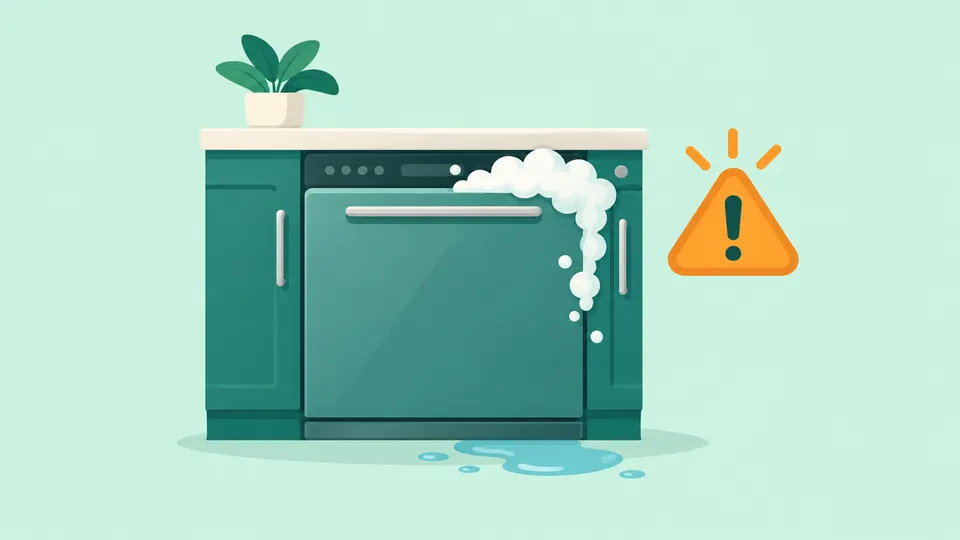
An AE code on an LG dishwasher means water has leaked into the base under the tub and lifted the leak float switch. LG lists too many suds, the wrong detergent, an unlevel unit and a door that does not seal as common causes. Turn off the breaker, fix the cause, dry the base pan, then run an empty cycle. If AE returns, request service.
On this page
Key Takeaways
- AE, E1 and FE are LG's leak and overfill codes for dishwashers; the float switch in the base pan has detected water.
- Most causes LG lists start outside the machinery: dish soap or too much detergent, overfilled rinse aid, an unlevel tub, a dirty door gasket or blocked spray arms.
- Shut off power at the breaker and close the water supply before you remove the kick plate or dry the base pan.
- Never disable or prop up the leak float. If AE comes back after an empty test cycle, LG says a technician needs to examine the unit.
What does the AE code mean on an LG dishwasher?
AE is LG's leak error. LG's dedicated help page says "an AE or E1 error code means you have a leak inside your dishwasher activating the float switch," and that you need to find and fix the cause before using the dishwasher again [1]. LG's main error code guide groups AE with FE under "Leakage/Overfilling" and says the error can also appear when the water supply exceeds the standard amount [2].
The float switch sits in a shallow pan under the tub. A small amount of water in that pan lifts the float, and the control stops the cycle. While an AE or FE code is showing, LG says the dishwasher keeps draining on purpose to protect the appliance and your floor. So a pump that runs on with the code displayed is the safety response, not a second fault [2].
Which code you see depends on the model. LG notes that codes vary by product, and owners see AE, E1 or FE for the same leak or overfill condition. If your display shows something else, check it in our error code lookup.
Is the LG washer AE code the same thing?
Not always. On LG front-load washers, AE also means a leak inside the machine that activated a safety switch, and LG's first check there is the inlet hose [5]. On LG top-load washers, LG groups AE with LE and LE1 as a rotation error, shown when the gears that turn the drum cannot work properly [6]. For that washer fault, see our LG washer LE code guide.
What causes the AE error on an LG dishwasher?
Every cause LG lists ends the same way: water gets past the tub and lands in the base pan. LG's error guide names five triggers: more water than the standard amount, oversudsing from dishwashing liquid, an unlevel unit or misaligned door, a real leak, and water poured into the Heat Dry blower [2].
| Cause | What you may notice | First fix |
|---|---|---|
| Dish soap or too much detergent | Foam at the door edges or on the floor | Use one pod, or fill only to the marked line |
| Overfilled or spilled rinse aid | Wet, sticky dispenser area; suds | Fill to the max mark and wipe spills |
| Unlevel unit or misaligned door | Water at the sides of the door | Check level; adjust the legs or request service |
| Dirty or torn door gasket | Grease or food on the seal; drips at the door | Clean it; a torn seal needs service |
| Loose supply connection | Wet paper towel at the joint under the unit | Call the installer or LG service |
| Water poured into the Heat Dry blower | AE right after filling the blower | Request service on built-in units |
Suds from the wrong detergent. LG says not to use dishwashing liquid in the dishwasher and warns that more than one pod or tablet "can lead to excessive suds and cause water to overflow" [1]. For liquid or powder, LG's leak guide says filling the whole dispenser beyond the marked levels leads to excess suds; use the 15 line for light loads or soft water and the 25 line for heavy soil or hard water [3].
Too much rinse aid. LG says to fill the rinse aid dispenser only up to its maximum mark, that excess rinse aid will leak, and to wipe off any spilled rinse aid to prevent suds [4].
An unlevel unit or door. LG's leak guide says water leaking from the sides of the door can mean the dishwasher was not leveled properly [3].
A dirty door gasket or blocked spray arms. Food or grease on the gasket can stop the door from sealing, and LG also asks owners to clean buildup from the spray arms [1].
A leaking connection. LG's leak guide points to the 90-degree elbow joint and the water supply line and suggests holding a dry paper towel around the joint to find wet spots [3].
How do you fix the LG dishwasher AE code?
Start with the causes you can see from the front, then dry the base pan so the float can drop. Turn off the dishwasher's circuit breaker and close the water supply valve under the sink before you remove the kick plate or reach under the unit. Water and electrical parts share that space.
Step 1: Cut power and water
Switch off the circuit breaker that feeds the dishwasher. LG's AE page puts this step before you touch the base pan [1]. LG's leak repair video also starts by turning off the water supply under the sink [3]. If water is on the floor, mop it up before you kneel near the unit.
Step 2: Remove the source of suds
If you used dish soap, more than one pod, or filled the cup past the line, that alone can explain the code. Wipe any rinse aid spills around the dispenser. If the tub still holds foam, LG's error guide gives a suds-clearing cycle under the related bE code: set rinse aid to L0, add no detergent, place a bowl with 200 ml (7 oz) of milk on the upper rack and run Standard with Extra Dry and Rinse, then restore your rinse aid setting [2]. Load large plates and pots upside down, as LG also advises for this error.
Step 3: Clean the gasket and spray arms, then check the level
Wipe food and grease from the door gasket and the tub edge it seals against. Remove the spray arms and clean them with a soft brush and warm soapy water, then refit them [1].
To check level, LG suggests placing a level on the top, sides and bottom, then removing the bottom rack and pouring about a gallon of water into the tub. If the water pools to one side, the unit is not level [1]. Adjusting the legs means removing the kick plate and mounting screws. LG's error guide simply says to request service if the unit is not level [2], so book a visit if you are not comfortable working under a built-in unit.
Step 4: Dry the base pan
With the breaker still off, remove the kick plate; LG says it is held by two Phillips screws, one on each side. Dry any water you can reach in the base pan. If there is no water, it may already have evaporated. If you cannot reach the pan from the front, LG suggests leaving the kick plate off for 24 to 48 hours so it dries [1].
Do not tape, hold down or remove the float switch to make the code go away. It is the part that stops a hidden leak from soaking your cabinet and subfloor.
Step 5: Reset and run an empty cycle
Refit the kick plate, open the water valve, and switch the breaker back on. LG says the power cycle resets the dishwasher; then run an empty cycle [1]. Watch the floor and the door edges during the first fill.
When should you call LG service for an AE code?
If AE comes back after you have used one pod or the correct detergent amount, LG says a technician needs to examine the dishwasher. LG's AE page also sends you to service when the door seal or a spray arm is damaged or torn [1].
Two more situations point straight to a repair. If the code shows but no water has reached the floor, LG says to unplug the dishwasher and request service [2]. And if water was poured into the Heat Dry blower on a built-in unit, LG advises service rather than a home fix.
A wet supply connection is also a technician or installer job in our view. LG's leak guide describes checking the elbow joint threads, the inlet valve and the supply line for wear [3], but those parts sit next to the wiring under the tub. We do not recommend opening the cabinet, replacing hoses, the pump or the inlet valve yourself unless you are trained.
If the drain side of the dishwasher is the problem instead, see our guide to a dishwasher that won't drain. Owners of other brands can compare the Samsung dishwasher LC code, Samsung's leak error, and the Bosch E24 code, a drain fault. You can also browse every LG appliance guide or all dishwasher repair guides.
How can you prevent the AE code from coming back?
Most of LG's causes are habits, so the same habits keep AE away in our reading.
| Product | LG guidance |
|---|---|
| Pods or tablets | One per cycle |
| Liquid or powder | 15 line for light soil or soft water; 25 line for heavy soil or hard water |
| Dishwashing liquid | Do not use it |
| Rinse aid | Fill to the max mark; wipe spills |
The detergent rules come from LG's leak guide [3], and the rinse aid rules come from LG's rinse aid guide [4].
Wipe the door gasket when you see buildup, clean the spray arms now and then, and never pour water into the Heat Dry blower. If a cleaning odor led you to over-dose detergent or rinse aid, our guide to a dishwasher that smells covers safer fixes.
Frequently Asked Questions
Is the LG dishwasher AE code the same as E1 or FE?
Yes, for practical purposes. LG's dedicated page treats AE and E1 as the same leak error, and its error guide lists AE with FE as a leak or overfill error. Which one you see depends on the model.
Why does my LG dishwasher keep draining with an AE code?
That is intentional. LG says the dishwasher keeps draining while an FE or AE error is active to protect the appliance and floor from leaks. Turn off the breaker before you investigate.
Can I keep using my LG dishwasher with an AE code?
Not until the cause is fixed. LG says to find and fix the leak before using the dishwasher again. If the code returns after the correct detergent and an empty cycle, book a repair.
Our Take
We think AE is worth troubleshooting yourself before you book a repair, because LG's own pages put suds, rinse aid, level and the door gasket ahead of any failed part. In our view the most useful step is the empty test cycle after drying the base pan: it tells you whether the leak came from how the last load was run or from the machine itself. We would never tape or remove the float to silence the code, and we would leave hoses, the inlet valve and anything near the wiring to LG service or a technician. Keeping to one pod and the rinse aid max mark is the cheapest way to avoid seeing AE again.
Sources
- AE & E1 Error Code - Dish Washer. LG Electronics, 2026.
- [LG Dishwasher] Guide to Error Codes. LG Electronics, 2025.
- LG Dishwasher - Troubleshooting Leaking Issues. LG Electronics, 2023.
- LG Dishwasher - How to Add Rinse Aid. LG Electronics, 2023.
- LG Front Load Washer - Error Code List (New). LG Electronics.
- [LG Top Load Washer] Error Code List. LG Electronics.
Repair information is general guidance. Unplug the appliance and shut off water or gas before working on it, follow your owner's manual, and call a qualified technician for gas, refrigerant or high-voltage work. Spotted an error? Tell us.
Related Fixes
Samsung Dishwasher LC Code: Finding the Leak
Samsung dishwasher LC or LE means the leak sensor found water in the base. Cut power and water, find the leak, let it dry, and know when to call for service.
Dishwasher Not Draining? How to Find and Fix the Cause
Dishwasher not draining? Clean the filter, then check the sink, disposal knockout plug, drain hose and air gap. Brand drain codes and when to call service.
Bosch Dishwasher E24 Error: Clearing the Drain
Bosch dishwasher E24 means water is not draining. Clean the filter, check the pump cover, hose, air gap and disposal plug, then reset. Call Bosch if it returns.
Why Does My Dishwasher Smell? How to Get Rid of It
Why does your dishwasher smell? Match the odor to its cause, clean the filter, spray arms and door seal, check the drain, and know when a smell means service.