Why Does My Dishwasher Smell? How to Get Rid of It
Quick Answer
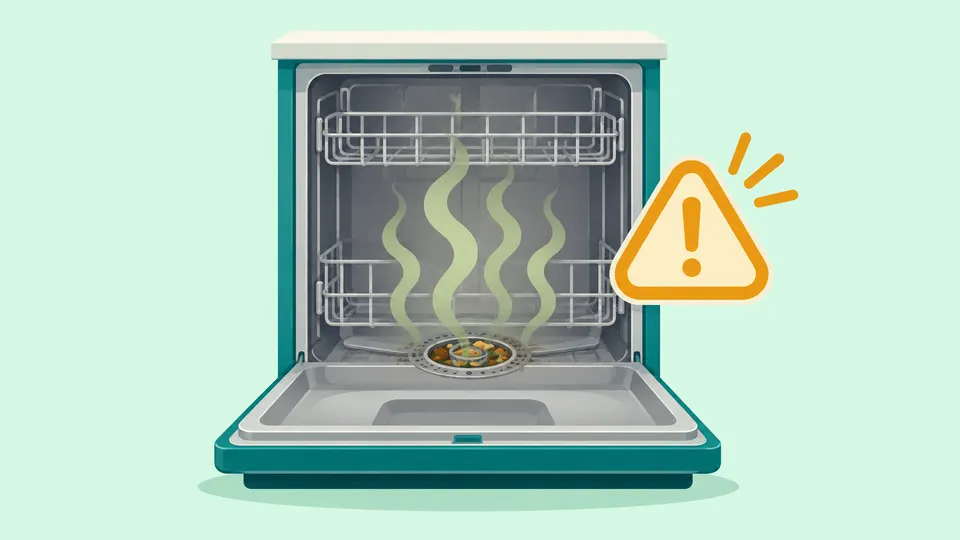
Most dishwasher smells come from food debris and water left inside the machine, usually in the filter, the spray arms, the bottom of the tub or the door seal. Whirlpool names trapped food and stagnant water from a drainage problem or a blocked filter as the causes. Turn off the power, clean the filter, spray arms and seal, check the drain, then run an empty cleaning cycle. A burning smell is different: switch off the breaker and call service.
On this page
- Why does my dishwasher smell?
- Is a burning smell from the dishwasher dangerous?
- How do you get rid of dishwasher smell?
- Can you use vinegar, baking soda or bleach in a dishwasher?
- Why does my dishwasher smell like sewage or rotten eggs?
- Is it normal for a new dishwasher to smell?
- How do you keep a dishwasher from smelling?
- Frequently Asked Questions
- Our Take
- Sources
Key Takeaways
- A dirty filter, food in the sump or spray arms, a grimy door seal and standing water cause most dishwasher odors.
- Turn off power at the circuit breaker before you remove the filter or spray arms.
- Use a dishwasher cleaner or a white vinegar cycle only the way your manufacturer describes, and never mix bleach with vinegar or any other cleaner.
- A sewage or rotten-egg smell can come from the sink drain, the disposal or the water supply, not the dishwasher itself.
- A burning or electrical smell means stop: turn off the breaker and call a technician.
Why does my dishwasher smell?
A dishwasher is warm, wet and full of food scraps, so anything left behind starts to smell. Samsung puts it simply: mold or mildew needs moisture, warmth and food particles, and a dirty dishwasher provides all three [8]. Whirlpool says food soils that fall into the tub or other parts of the dishwasher can decompose and cause odors [2].
The type of smell is a useful clue to where it starts.
| What it smells like | Likely source | What to do first |
|---|---|---|
| Rotten food, musty, mildew | Filter, sump, spray arms, door seal | Clean them, then run an empty cleaning cycle |
| Sewage or drain smell | Standing water, sink drain or garbage disposal | Check the drain and run the disposal |
| Rotten eggs | Food debris, or hydrogen sulfide in the water supply | Clean the dishwasher, then smell the hot tap |
| New plastic, petroleum or varnish | New tub, sound-deadening material or motor | Normal; it fades over a few weeks |
| Melted plastic or charred food | Plastic or food on the heating element | Let it cool, remove the debris |
| Burning or electrical | Possible electrical fault | Turn off the breaker and call service |
The table draws on the cause lists from Whirlpool [1] and Samsung [8]; each row is explained below.
Is a burning smell from the dishwasher dangerous?
A burning or electrical smell is the one dishwasher odor you should not clean away: turn off power at the circuit breaker and call a technician. KitchenAid tells owners to call a technician right away if they notice a burning smell, damaged wiring or repeated breaker trips [7]. Do not open the toe panel or control panel to look for the cause.
A smell of melted plastic or charred food is more often debris on the heating element. Whirlpool says plastic parts or food particles can fall onto the element during a cycle. Its fix is to let the dishwasher cool for at least 30 minutes, then scrape debris off the element with a non-metallic tool such as a wooden spoon; excess plastic burns off after a few cycles [4]. Turn off power at the breaker before you reach in. Whirlpool also says to wash only dishwasher-safe plastic, on the upper rack. If you see no melted debris, or the smell is sharp and electrical, treat it as a burning smell and call service.
How do you get rid of dishwasher smell?
Clean the parts that trap food, then check the drain, then run an empty cleaning cycle. Each step below is short; your owner's manual shows the exact parts on your model.
Step 1: Turn off the power
Turn off power at the circuit breaker before you remove the filter or the spray arms. KitchenAid gives cutting power at the breaker, not only at the control panel, as the first step before reaching into the tub [7]. If the last cycle was hot, let the tub cool first.
Step 2: Clean the filter and sump
The filter is the first place to look. Whirlpool says to remove the drain filter, usually at the bottom of the dishwasher, rinse it under hot water and clean it at least once a month [1]. On many KitchenAid models you turn the upper filter assembly a quarter turn counterclockwise, lift it out, pull it apart and rinse it, with a soft brush for stubborn soil or hard-water deposits [6].
Not every filter comes out. KitchenAid describes a maintenance-free filter style with a foreign object cup that you empty when it fills [6]. Samsung says to clean the drain area and filter housing with warm, soapy water as well [8]. Reseat the filter until it locks before you run the dishwasher again.
Step 3: Clear the spray arms
Food can lodge in the small holes of the spray arms. Samsung's odor guide says to remove the racks, baskets and nozzles, and to clear the nozzle holes with a thin pointed object such as a needle or toothpick [8]. If your spray arms do not come off without tools, clean them in place and follow your manual.
Step 4: Wipe the door seal and door bottom
Whirlpool says to wipe the rubber door seals and interior surfaces with a damp cloth and mild detergent [1]. Samsung suggests a damp cloth soaked in white vinegar for the door seal and warm, soapy water for the bottom of the door, which the seal does not reach [8].
Step 5: Check the drain and the disposal
Water that sits in the tub after a cycle smells fast. A little water below the filter is normal on some models: LG says it keeps sewer smells from coming back into the tub [9]. Water pooling above the filter is a drain problem; our guide to a dishwasher that won't drain walks through the filter, hose, air gap and sink checks.
If the dishwasher drains into a garbage disposal, Whirlpool says to run the disposer to clear debris, then clean both the dishwasher and the disposer [5]. If the disposal hums or won't run, see our garbage disposal troubleshooting guide.
Step 6: Check the hot water, then run a cleaning cycle
Samsung suggests running hot water at the sink and timing how long it takes to get hot. If it takes more than about a minute, check the water heater; Samsung gives a heater setting of 120 to 149°F, and says to call a plumber if the heater is set correctly and the water still is not hot [8].
Restore power and run an empty cycle with a cleaner your manufacturer approves. Whirlpool suggests placing a dishwasher cleaner as its instructions direct and running a hot cycle with no dishes about once a month [1]. Some models have a Self Clean cycle; Samsung says to use Self Clean or Normal depending on the model [8]. Leave the door slightly open afterward so the tub can dry.
Can you use vinegar, baking soda or bleach in a dishwasher?
Use only what your manufacturer allows, and follow its method. The brands differ on the details.
- White vinegar. Whirlpool's vinegar rinse uses 2 cups (500 mL) of white vinegar in an upright glass measuring cup on the lower rack, a normal cycle with the heated dry turned off, and no detergent [2]. For a new-tub smell it also says to remove silverware and metal items first [3]. Samsung's method is different: run an empty cycle until it drains, pause it, add 8 ounces of white vinegar in a dishwasher-safe glass on the bottom rack, then resume, and do not combine detergent and vinegar [8].
- Dishwasher cleaners. Whirlpool recommends its affresh dishwasher cleaner every 30 days [2]. affresh is a Whirlpool Corporation brand, so other makers may name different products. Samsung lists a dishwasher cleaning tablet used as its maker directs [8].
- Bleach. Samsung says: "Do not use bleach in a dishwasher with a stainless steel interior, as it may damage or discolor the interior" [8].
- Baking soda. None of the manufacturer odor pages we used gives a baking soda method, so we do not give one here. Check your owner's manual.
Never mix bleach with vinegar or any other cleaner. The CDC says never to mix household bleach with other cleaners or disinfectants, because it can release vapors that may be very dangerous to breathe [10]. Run one product per cycle, and never add a second cleaner to a tub that still holds another.
Why does my dishwasher smell like sewage or rotten eggs?
A sewage smell usually means water from the drain is reaching the tub or sitting in it. Clean the filter first, then follow Step 5: check for standing water above the filter, run the disposal and test the sink drain. Samsung says that if odor persists, clean the sink drain or garbage disposal, and if the smell continues, call a plumber before cleaning the dishwasher again [8].
A rotten-egg smell can come from the dishwasher's own debris, but it can also arrive with the water. Smell the hot water at the kitchen tap. Penn State Extension says hydrogen sulfide, the gas behind a rotten-egg odor in water, forms when sulfur-reducing bacteria grow in low-oxygen wells and plumbing [11]. If the rotten-egg odor appears only in hot water, Penn State Extension points to the water heater's magnesium anode rod as the likely source. It describes replacing that rod with an aluminum one [11]; that is a water heater job for a plumber, not a dishwasher repair. If the smell is in both hot and cold water from a private well, a water test is the next step.
Samsung also notes that if the dishwasher works properly despite the odor, appliance service will not correct it [8].
Is it normal for a new dishwasher to smell?
Yes, for a while. Whirlpool says a new plastic smell is normal and should fade in about two weeks; some models with sound-deadening material give off a petroleum smell that fades in 4 to 6 weeks; and a varnish smell from the motor windings should wear off in about one month [1]. A white vinegar rinse or a dishwasher cleaner may help the plastic smell fade [3].
If a new dishwasher smells of sewage or has water standing above the filter, that is not a new-appliance smell. Check the drain hose and disposal connection; a pinched hose or a disposal knockout plug left in place are common install problems covered in our dishwasher drain guide.
How do you keep a dishwasher from smelling?
Prevention is mostly about not leaving food and water inside.
- Clean the filter on schedule. Whirlpool says at least once a month [1]; some KitchenAid models have a Clean Filter indicator [6].
- Rinse partial loads. KitchenAid suggests a Rinse and Hold or Rinse Only cycle without detergent every 24 hours if you do not have a full load [6].
- Scrape, don't prewash. KitchenAid advises scraping off large food particles instead of hand washing dishes first [6].
- Load for good spray. Whirlpool says to avoid overcrowding and keep large items from blocking the spray arms [1].
- Let it dry. Samsung suggests leaving the door slightly open when the dishwasher is not in use and wiping the tub and inside of the door after cycles [8].
If the smell comes back with a code on the display, look it up in our error code lookup. A Samsung LC code or an LG AE code points to a leak, not an odor; see our Samsung LC code guide and LG AE code guide. Bosch owners with a drain warning can start with the Bosch E24 guide. More fixes are in our dishwasher repair guides.
Frequently Asked Questions
Can I use bleach to clean a smelly dishwasher?
Check your manual first. Samsung says not to use bleach in a dishwasher with a stainless steel interior, because it may damage or discolor the interior. Never mix bleach with vinegar or any other cleaner; the CDC warns the vapors can be dangerous to breathe.
Why does my new dishwasher smell like plastic?
Whirlpool says a new plastic smell is normal and should fade in about two weeks. A petroleum smell from sound-deadening material can take 4 to 6 weeks. A white vinegar rinse or a dishwasher cleaner may help.
Should I leave the dishwasher door open to stop odors?
Samsung suggests leaving the door slightly open when the dishwasher is not in use so moisture can escape. Some models open the door automatically at the end of a cycle.
Our Take
We think most smelly dishwashers need cleaning, not repair. Every manufacturer page we used starts with the same parts: the filter, the sump, the spray arms and the door seal. In our view the smell itself is the best first diagnostic. A musty or rotten-food smell means clean; a sewage smell means look at the drain, sink and disposal; a rotten-egg smell that also comes out of the hot tap belongs to the water heater or supply, not the dishwasher. We would use only the cleaner and method your own manufacturer describes, one product per cycle, and never bleach with vinegar. A burning smell is the exception we would never try to clean away: breaker off, then service.
Sources
- Removing Odors in your Dishwasher. Whirlpool.
- Food Odors - Dishwasher. Whirlpool.
- Plastic Tub Odor - Dishwasher. Whirlpool.
- Melted Plastic or Charred Food Odor - Dishwasher. Whirlpool.
- Odor From Garbage Disposal - Dishwasher. Whirlpool.
- How to Clean the Dishwasher Filters. KitchenAid.
- Dishwasher Not Draining. KitchenAid.
- Samsung Dishwasher stinks or has a musty smell. Samsung Electronics America.
- [LG Dishwasher] Guide to Error Codes. LG Electronics, 2025.
- Cleaning and Disinfecting with Bleach. Centers for Disease Control and Prevention.
- Hydrogen Sulfide (Rotten Egg Odor) in Water Wells. Penn State Extension.
Repair information is general guidance. Unplug the appliance and shut off water or gas before working on it, follow your owner's manual, and call a qualified technician for gas, refrigerant or high-voltage work. Spotted an error? Tell us.
Related Fixes
Dishwasher Not Draining? How to Find and Fix the Cause
Dishwasher not draining? Clean the filter, then check the sink, disposal knockout plug, drain hose and air gap. Brand drain codes and when to call service.
Garbage Disposal Not Working? 7 Fixes to Try First
Garbage disposal not working? Check power and the reset button, free a jam with the hex wrench, clear a clog, and know when a disposal needs replacing.
Samsung Dishwasher LC Code: Finding the Leak
Samsung dishwasher LC or LE means the leak sensor found water in the base. Cut power and water, find the leak, let it dry, and know when to call for service.
LG Dishwasher AE Code: Leak Sensor Fixes
LG dishwasher AE code means water reached the base pan and tripped the leak float. Fix suds, level the unit, clean the door gasket, dry the pan, then retest.
Bosch Dishwasher E24 Error: Clearing the Drain
Bosch dishwasher E24 means water is not draining. Clean the filter, check the pump cover, hose, air gap and disposal plug, then reset. Call Bosch if it returns.