Refrigerator Leaking Water Inside or Underneath? Find the Source
Quick Answer
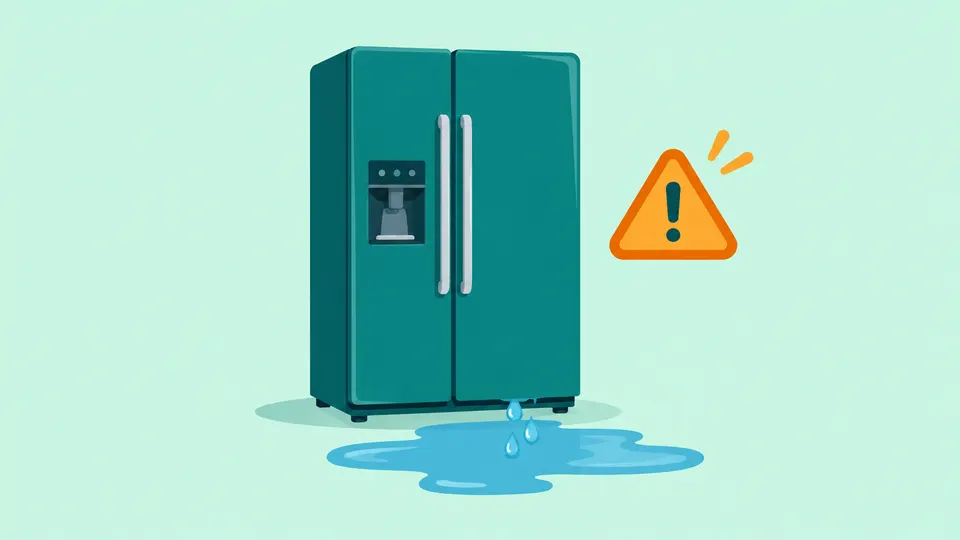
Where the water sits tells you what to check. Water inside the fridge or under the crisper drawers usually traces back to the defrost drain, a door that does not seal or a cabinet that is not tilted back. A puddle underneath or in front points to the water supply line, its fittings, the water filter or the drain pan. Dispenser drips often come from the drip tray or a filter that is not seated.
On this page
- Where is the water coming from?
- Why is there water inside the fridge or under the crisper drawers?
- How do you clear a clogged defrost drain?
- Why is water pooling underneath or in front of the fridge?
- Why does the ice and water dispenser drip?
- When should you call a technician?
- Frequently Asked Questions
- Our Take
- Sources
Key Takeaways
- Find the water before you fix anything: inside the cabinet, under the crisper drawers, on the floor in front, behind the refrigerator or at the dispenser. Each spot has a short list of causes.
- A clogged or frozen defrost drain can push water into the cabinet or onto the floor. GE says ice under the bottom freezer basket plus a puddle on the floor is the usual sign.
- Clear a defrost drain only the way your owner's manual describes. GE says built-in and most freestanding models need service for a clogged drain.
- Shut off the water supply valve before you touch the supply line, and unplug the refrigerator before you move it or remove any cover.
- Whirlpool lists a water filter that is not locked in, cracked or incompatible among the causes of leaks on models with a filter.
Where is the water coming from?
Start by drying everything with towels, then watch where new water appears over the next few hours. Samsung notes that melting ice or spills from elsewhere are often mistaken for leaks, so confirm the water really comes from the refrigerator [14]. A spill in a door bin, a dish rack nearby or a dishwasher that is not draining can all leave water at the base of the fridge.
| Where you find water | Most likely causes | Go to |
|---|---|---|
| Shelves or the floor of the fresh food section | Defrost drain, door seal, level, condensation | Inside the fridge |
| Under the crisper drawers | Defrost drain, water tank (some side-by-sides) | Inside the fridge |
| Ice under the bottom freezer basket | Clogged or frozen defrost drain | Clearing the drain |
| Floor in front, once or twice a day | Defrost drain overflowing | Clearing the drain |
| Floor in front or behind, steady | Supply line, fittings, valve, filter, drain pan | Underneath |
| Below the dispenser | Drip tray, ice shavings, filter, door tubing | Dispenser |
Why is there water inside the fridge or under the crisper drawers?
Water inside the cabinet usually means water that should have drained is backing up, or warm, humid air is getting in. Samsung lists a blocked defrost drain, a door that does not close properly and incorrect leveling among the causes of leaks [14].
A blocked or frozen defrost drain. During defrost, water runs down a drain tube to a pan underneath the refrigerator [10]. If debris or ice blocks the drain, the water has nowhere to go, so it collects in the cabinet or spills toward the front. The next section covers how manufacturers say to clear it.
Door seals. Samsung says a door that does not close properly lets the appliance warm up "and water will begin to form," and suggests closing the door on a sheet of paper: if the paper slides out with no resistance, the seal needs repair or replacement [14]. Whirlpool adds checks for anything caught between the gasket and the cabinet and for blocked air vents [9].
Level and tilt. Samsung says the refrigerator should tilt slightly backward, set with the front legs, because water may not drain properly if the cabinet sits level or leans forward. When the tilt is right, the door should swing shut on its own [14]. Whirlpool says shims may be needed on an uneven floor and points to the owner's manual for leveling steps [9].
Normal condensation. A few drops are not always a leak. Whirlpool says "a minimal amount of condensation is normal, especially during higher humidity conditions" [8]. The same page asks owners to check that the water filter is installed correctly, is not damaged and still has its O-rings, since on some models the filter sits inside the fresh food section.
Water under the crisper drawers
GE treats this symptom differently by design. On its bottom-freezer and French-door models, GE says water or ice under the pans "is not normal and cannot be corrected by the owner" and needs service [12]. GE top-freezer models with this problem also need service [13]. On GE side-by-side models, a leaking water storage tank can be the cause: pull out the drawers, dispense water into a glass and watch the tank, and if it leaks, GE recommends service [11]. Other brands may differ, so check your owner's manual.
How do you clear a clogged defrost drain?
Clear a defrost drain only if your owner's manual shows how; on many models it is a service job. GE says "Built-In models and most Freestanding models require service to correct the issue," and that service is required if you cannot see a drain hole [10].
GE's usual evidence of a clog on side-by-side models is ice under the bottom freezer basket, plus water on the floor in front of the refrigerator once or twice a day. On the freestanding models owners can fix, the drain hole is on the freezer's back wall, in the center, just above where the floor slopes up, or behind a plastic panel held by one screw. GE's steps for those models [10]:
- Unplug the refrigerator before you remove any panel inside the freezer.
- Mix 1 tablespoon of baking soda into 2 cups of hot tap water.
- Use a meat or turkey baster to squeeze the solution into the drain hole.
- Listen: when the drain is clear, you will hear water running down into the drain pan below.
- Put the panel back and restore power. For prevention, GE suggests the same solution, hot but not boiling, once or twice a year.
Samsung describes the drain as a small hole at the back bottom of the freezer, sometimes behind a removable panel held by screws, and says to clear it by hand or flush it with warm water [14]. Neither page tells owners to chip ice, use sharp tools or apply heat, so we would not. Ice that keeps building up around the drain may point to the defrost system itself, which is technician work.
Why is water pooling underneath or in front of the fridge?
On a refrigerator with an ice maker or dispenser, a steady puddle underneath often comes from the water connection rather than the drain. Whirlpool's checks for water at the bottom of the refrigerator start with the supply system [3]:
- Turn off the household water supply valve before you touch the supply line or any fitting.
- Check that the line from the household water supply to the refrigerator is not cracked or damaged.
- Check the connections at the supply valve, whether a saddle valve or a shut-off valve, and where the tubing meets the back of the refrigerator. Whirlpool says to "ensure the tubing is firmly inserted into all fittings and all fittings are tightened" [2].
- Remove the water filter and look for cracks and missing O-rings. Replace a cracked filter.
The water filter. Whirlpool says incorrect, incompatible or overdue filters can cause drips at the filter head or connected lines, and recommends a filter approved for your model, installed and locked as the Use and Care Guide directs [1]. It recommends replacing the filter about every 6 months, when the indicator light comes on, or as needed, because minerals can wear the housing over time. If the filter leaks and you cannot replace it right away, Whirlpool says you can remove it and the system will run in bypass mode [3]. Bypass applies to the models that page covers; check your manual first.
A filter that was just replaced is a prime suspect. Whirlpool's test: remove the filter and try to dispense water. If water still comes out, the filter was not installed correctly, so reinstall it until it locks [4].
The drain pan. Samsung says condensation "is supposed to run into a drip pan hidden underneath your appliance," usually at the back behind a metal cover at the bottom, and suggests removing it and washing out any build-up [14]. Samsung also asks owners to check the hoses and connections on the back for loose or damaged parts. Unplug the refrigerator before you remove that cover, and look for cracks in the pan or signs that it sits out of place.
Safety before you pull the fridge out
- If water has reached the outlet or the power cord, switch off the circuit breaker before you touch the plug.
- Unplug the refrigerator before you move it or take off any cover or panel.
- A refrigerator is heavy and can tip. Whirlpool's leaking page carries an "Excessive Weight Hazard" warning [2]; move it with a helper, slowly, and watch the water line so it does not kink or pull loose.
- Never bend or open the refrigerant tubing. Sealed-system repairs belong to a licensed technician.
Why does the ice and water dispenser drip?
A few drops after you fill a glass are expected. Whirlpool says some water drips after you release the lever and suggests holding the glass in place for a few extra seconds [5]. Its other dispenser checks on the same page:
- Empty the drip tray. A full tray can overflow down the front of the refrigerator. Push down on the rear edge of the insert to tilt it, then pull it out and empty it at the sink.
- Clear ice shavings. Crushed ice leaves residue in the chute that melts and drips. After using crushed ice, dispense 8 to 10 ice cubes.
- Check a newly replaced filter. A filter that is not locked in and sealed can leak from the housing.
If water leaks at the top of the door on a French-door model, Whirlpool says the dispenser tubing under the left hinge cover may not be connected, especially if the doors were removed during delivery [6]. For leaks around the ice maker, Whirlpool points to the filter and to a loose water connection, which it says "could cause the water dispenser to drip occasionally or continuously" [7]. If the ice maker has also stopped making ice, our Whirlpool ice maker guide walks through the water supply checks in order.
When should you call a technician?
Call for service when the owner checks do not stop the leak, or when the cause sits behind a panel. Whirlpool sends owners to its service line once the basic steps are done [3], and GE says to schedule service if water keeps reaching the floor after the drain is flushed [10].
Call sooner if you see any of these:
- Water or ice under the crisper drawers on a GE bottom-freezer, French-door or top-freezer model.
- No drain hole you can reach, or ice that returns around the drain after you flush it.
- Water near an outlet, the cord or the machine compartment that you cannot dry and trace.
- A leak together with a warm fresh food section. Our guide to a refrigerator that is not cooling covers that symptom, and LG owners have their own checks.
- An error code on the display. Look it up in our error code lookup before you book.
Anything involving refrigerant lines or the compressor is a sealed-system repair for a licensed technician. For more brand-specific help, see our Whirlpool, GE and Samsung pages, or browse all refrigerator repair guides.
Frequently Asked Questions
Is it normal to see some water inside the refrigerator?
A little condensation is normal, especially in humid weather or after the door has been open a while. Whirlpool says some frost and sweating on interior walls or food packages can be normal during humid months. Standing water on the floor of the cabinet or under the crisper drawers is not, and points to the drain, the door seals or the level.
Can a new water filter make my refrigerator leak?
Yes. Whirlpool says a filter that is not locked in place or sealed can leak from the housing. Remove it and try to dispense water: if water still flows, reinstall the filter. Also check that it is the correct filter for your model, that it is not cracked and that its O-rings are in place.
Should a refrigerator tilt forward or backward?
Backward, slightly. Samsung says water may not drain properly if the refrigerator sits level or tilts forward, and that a correctly set cabinet lets the door swing shut on its own. Your owner's manual shows how to adjust the front legs or rollers.
Our Take
We think the most useful five minutes you can spend on a leaking refrigerator is drying the area and watching where water comes back. That single clue sorts most leaks into the drain, the seals and level, or the water supply. In our view, the supply side is the place to start on any fridge with a dispenser: shut the valve, check the fittings and reseat the filter, which are the first causes Whirlpool lists. We would only flush a defrost drain that the owner's manual shows how to reach, because GE says most of its models need service for a clog, and we would not chip ice or apply heat inside the freezer.
Sources
- What to Do if There is Water on the Floor. Whirlpool.
- Leaking from Behind - Top Freezer Refrigerator. Whirlpool.
- Leaking at the Bottom - Bottom Freezer Refrigerator. Whirlpool.
- Leaking from the Filter Area - Bottom Freezer Refrigerator. Whirlpool.
- Leaking from Dispenser - Bottom Freezer Refrigerator. Whirlpool.
- Leaking at the Top - Bottom Freezer Refrigerator. Whirlpool.
- Leaking from the Ice Maker - Bottom Freezer Refrigerator. Whirlpool.
- Water Inside Refrigerator. Whirlpool.
- Condensation in the Refrigerator Section - Refrigerator. Whirlpool.
- Side-by-Side Refrigerator - Water on Floor, Repairing a Clogged Defrost Drain. GE Appliances.
- Side-by-Side Refrigerator - Water or Ice Under Vegetable Pan/Bin. GE Appliances.
- Bottom Freezer Refrigerator - Water or Ice Under Vegetable Pan/Bin. GE Appliances.
- Top-Freezer Refrigerator - Water or Ice Under Vegetable Pan/Bin. GE Appliances.
- What should I do if I suspect my Samsung fridge freezer is leaking water?. Samsung UK.
Repair information is general guidance. Unplug the appliance and shut off water or gas before working on it, follow your owner's manual, and call a qualified technician for gas, refrigerant or high-voltage work. Spotted an error? Tell us.
Related Fixes
Refrigerator Not Cooling but Freezer Works? Start Here
Fridge warm but freezer cold? Check the thermometer, settings, vents, door seals and coils, look for frost or a silent fan, and learn when to call a pro.
Whirlpool Ice Maker Not Working: Step-by-Step Checks
Whirlpool ice maker not working? Check that it is on, set the freezer to 0 to 5°F, inspect the filter, water line and pressure, and clear jammed or clumped ice.
LG Refrigerator Not Cooling: Linear Compressor and Other Causes
LG fridge not cooling? Turn off demo mode, decode Er FF, Er rF and other LG codes, check settings and airflow, and learn what LG's compressor warranty covers.