Refrigerator Not Cooling but Freezer Works? Start Here
Quick Answer
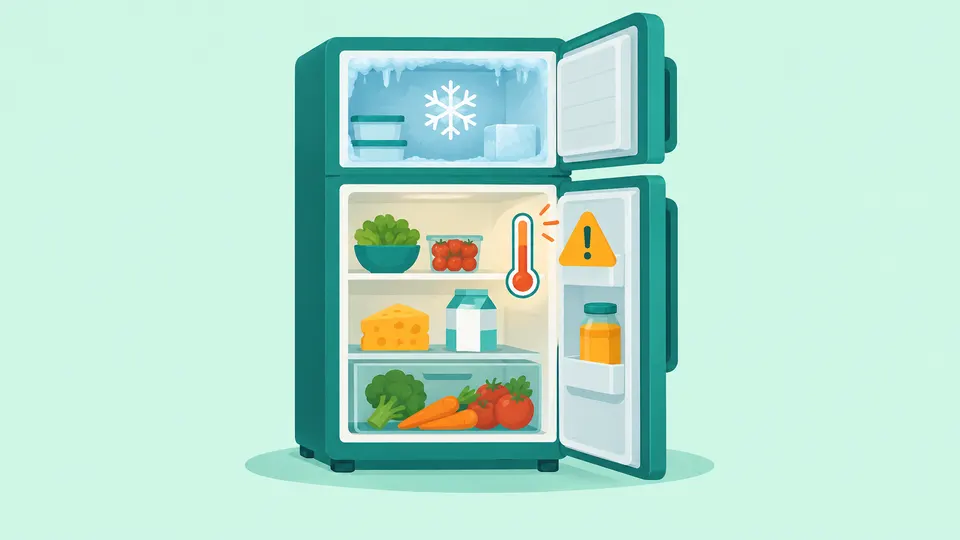
When the freezer stays cold but the refrigerator turns warm, in most refrigerators cold air is not getting from the freezer to the fresh food section. Check the thermometer and settings first, then clear blocked vents, test the door seals and clean the condenser coils. Heavy frost that keeps returning on the freezer's back wall, or a silent fan, points to parts a technician should check.
On this page
Key Takeaways
- In most refrigerators one evaporator in the freezer makes all the cold air, and a fan and damper share it with the fresh food section. A blockage on that path can warm the fridge while the freezer stays cold.
- Start with free checks: a thermometer reading, the temperature control, demo or showroom mode, blocked vents, door seals and room temperature. Wait 24 hours after any change.
- Unplug the refrigerator before you clean the condenser coils or remove any panel.
- Heavy frost on the freezer's back wall, a fan you can no longer hear, or warm temperatures that survive every check mean a service call. Refrigerant and compressor work is for a licensed technician.
- Keep the fridge at or below 40 °F. If it has stayed warmer, check your food before you eat it.
Why does the freezer stay cold when the fridge gets warm?
Most refrigerators do not cool the two sections separately. GE explains that "conventional refrigeration uses only one evaporator that cools the freezer," and the cold air from that coil is then sent into the fresh food section [4]. A fan behind the freezer's back panel moves the air; GE's owner's manual describes the evaporator fan sound as "air being forced through the cabinet by the fan" [5]. A damper then meters how much of it reaches the fridge. In GE's words, "cold air is circulated from the freezer to the fresh food compartment via a damper" [3].
That shared path explains the symptom. The freezer sits right next to the coil, so it can stay cold even when the air supply to the fridge is weak. Anything that slows the flow, whether frost on the coil, a fan that has stopped, a damper stuck shut or a box pushed against a vent, starves the fresh food section first. Some refrigerators, such as GE models with dual evaporators, cool each section with its own coil instead [4]. On those, follow your owner's manual and the manufacturer.
What should you check first?
Put an appliance thermometer in the middle of the fridge: FDA says the refrigerator should be at or below 40 °F and the freezer at 0 °F. FDA calls appliance thermometers "the best way of knowing these temperatures" [9].
| Check | What the manufacturer says | Wait before rechecking |
|---|---|---|
| Temperature control | Factory setting is the mid setting (Whirlpool) | At least 24 hours between adjustments (Whirlpool) |
| Demo, showroom or Cooling Off mode | Lights work but the unit does not cool; turn the mode off (Samsung, Whirlpool) | See your manual |
| Vents inside the fridge | Keep food about 2 inches from vents (Samsung); do not block vents with food packages (Whirlpool) | Recheck after 24 hours |
| Door seals | Close the door on a dollar bill or paper; you should feel resistance (Frigidaire, Samsung) | Test right away |
| Clearance and room | 2 inches at back, top and sides (Samsung); room between 55 °F and 110 °F (Whirlpool) | 24 hours |
| Large load of warm food | Temperatures take time to settle (Whirlpool) | Several hours (Whirlpool) |
Whirlpool says controls are factory-set to the mid setting and tells owners to "wait at least 24 hours between adjustments" [1]. Samsung lists its "Cooling Off Mode, sometimes called Demo mode or Shop mode," as a reason a fridge will not cool at all, and asks for 2 inches of clearance at the back, top and sides, with food kept 2 inches from the interior vents [6]. On Whirlpool side-by-side models, bulky items that block the return air vents can warm the fresh food section [2].
For the door seal, Frigidaire's test is simple: close the door on a dollar bill and pull. "You should feel a bit of resistance." If the bill slides out easily, the seal is weak; clean the gasket with warm soapy water and test again [8]. Samsung adds that a warped or damaged seal needs service [6].
Whirlpool also says its refrigerators are meant for indoor rooms between 55 °F and 110 °F, and that a garage outside that range may cause poor cooling [1].
Could frost, a fan or the damper be the problem?
If the settings, vents and seals are fine, look at what moves air out of the freezer: the evaporator coil, its fan and the damper. If your display shows a code, our error code lookup explains it by brand.
The evaporator coil (frost on the back wall). Samsung says frost "is caused by warm moist air getting inside, then freezing," and that frost on the vents blocks airflow, so it has to be cleared or more will build up [7]. Light frost can be wiped with a damp cloth; Samsung warns, "Do not use a hair dryer to speed defrosting. This will damage the refrigerator." A thick sheet of ice across the back panel is different. In our reading, it suggests ice on the evaporator coil behind the panel, which a fault in the automatic defrost system can cause. Samsung says to request service if frost keeps coming back.
The evaporator fan. On a frost-free refrigerator the evaporator fan is the part you normally hear moving air inside the cabinet [5]. Listen at the freezer with the doors closed, and check again after a few minutes. If the freezer is running but you still cannot hear or feel air from its vents, the fan may have stopped.
The damper. GE's manual for its top-freezer models says "the freezer control moves a damper to change the amount of cold air that moves from the freezer to the fresh food compartment" [5]. On GE bottom-freezer models the fresh food control regulates that damper instead [3]. In our reading, a damper stuck closed would cut off the fridge's cold air while the freezer keeps working.
Do not chip ice off the back panel, remove panels while the refrigerator is plugged in, or try to open the sealed refrigerant system. Defrost heaters, fan motors and electronic dampers sit behind panels with wiring, so their repair belongs to a technician.
Do dirty condenser coils cause a warm fridge?
They can. Whirlpool lists dirty condenser coils among the causes of a refrigerator section that is not cooling [2]. Manufacturers disagree on how often to clean them. Whirlpool's general not-cooling page says coils may need cleaning "as often as every other month" [1], while its side-by-side page says routine cleaning is usually unnecessary except every 2 to 3 months in greasy, dusty or pet-heavy homes. GE's older manual says to clean them at least once a year [5]. ENERGY STAR tells owners of older models to keep the coils clean and to "read the user's manual to learn how to safely clean coils" [11].
Some models can only be cleaned by a certified technician, so check your owner's manual first. Whirlpool's steps for models with coils behind the base grille [1]:
- Unplug the refrigerator or switch off its breaker before you touch the grille or the coils.
- Open the door and remove the base grille (on many models, two Phillips-head screws).
- Vacuum the grille, the open area behind it and the front of the condenser with a soft brush attachment.
- Put the grille back and restore power.
Do not bend the coil tubing; it is part of the sealed refrigerant system.
Is the food in a warm refrigerator still safe?
Not always. If the fresh food section has stayed above 40 °F, perishable food may no longer be safe, even if the freezer is fine. FDA sets the refrigerator limit at 40 °F [9]. Its power outage guidance says to throw out refrigerated perishable food that has been "at refrigerator temperatures above 40°F for 4 hours or more" [10]. That page is written for outages, but a fridge that runs warm puts food in the same situation.
While you troubleshoot and the thermometer reads above 40 °F, keep milk and leftovers in a cooler with ice, and freeze meat you will not use soon. If water is pooling under the crisper drawers at the same time, a blocked defrost drain may be involved; our guide to a refrigerator leaking water covers that.
When should you call a technician?
Call for service when the cheap checks are done and the thermometer still reads above 40 °F after 24 hours. Samsung says to request service "if the steps above are done and food still spoils early" [6], and Whirlpool and Frigidaire both point owners to their service lines after the basic list [1] [8]. Frigidaire adds that a unit installed within the past 30 days should go back to the installer.
If the freezer is warming too, the checks change. Confirm the refrigerator has power and that Cooling Off or demo mode is off, then try Samsung's power cycle: unplug it or switch off its breaker for 2 minutes [6]. Clean the condenser coils and check the clearance around the cabinet. GE lists the condenser fan among normal sounds, with air "forced over the condenser by the fan" [5]. If you cannot hear it while the compressor runs, mention that to the technician. If both sections stay warm after that, the sealed system needs a licensed technician.
Call sooner if you see any of these:
- A thick layer of ice across the freezer's back panel, or frost that returns after you clear it.
- No fan sound or airflow from the freezer vents.
- An error code on the display that your manual says needs service.
- Both sections warming after the checks above. Refrigerant leaks and compressor faults are sealed-system repairs that only a licensed technician should handle.
If your refrigerator is an LG, see our LG refrigerator not cooling guide for LG-specific checks. Whirlpool owners with an ice maker that stopped at the same time can also read our Whirlpool ice maker guide. For an older refrigerator, the repair quote is worth weighing against replacement: ENERGY STAR says an old refrigerator uses about 20% more energy on average than a certified model [11]. You can browse all our refrigerator repair guides for other symptoms.
Frequently Asked Questions
How long does a refrigerator take to cool down after I change the setting?
Whirlpool and Frigidaire say to allow 24 hours for temperatures to stabilize, and Whirlpool says to wait at least 24 hours between adjustments. Samsung allows up to 28 hours for the temperature to reach a new setting with the doors closed.
Will unplugging the refrigerator reset it?
Sometimes. Samsung suggests a power cycle: unplug the refrigerator or switch off its breaker for 2 minutes, then restore power. A reset can clear a control glitch, but it will not fix a frosted coil, a failed fan or a stuck damper. Never use a hair dryer on frost.
Why is my fridge warm but the freezer has ice buildup?
Heavy ice on the freezer's back wall can block the vents that feed the fresh food section. Samsung says frost forms when warm, moist air gets inside, so check the door seals first. If a thick layer keeps coming back, have a technician check the defrost system.
Our Take
We think most readers with this symptom should spend a day or two on the free checks before booking a repair. A thermometer reading, the control setting, clear vents, a dollar-bill test on the seals and a coil cleaning cover the causes manufacturers list first. In our view the most telling clue is the freezer's back wall: a thick sheet of ice or a silent fan points to parts inside the cabinet, and at that stage we would call a technician rather than chip at the ice. If the thermometer has read above 40 °F for hours, move milk and leftovers to a cooler with ice and freeze meat you will not use soon while the fridge gets fixed.
Sources
- Not Cooling. Whirlpool.
- Not Cooling - Refrigerator Section - Side by Side Refrigerator. Whirlpool.
- Refrigerator - Adjusting Temperature Controls. GE Appliances.
- Refrigerator - ClimateKeeper Dual Evaporator and ClimateKeeper2 Systems. GE Appliances.
- Top-mount No-frost Refrigerators Owner's Manual (Pub. No. 49-60012). GE Appliances, 1998.
- Cooling issues with Samsung refrigerator or freezer. Samsung.
- Frost forms in the Samsung freezer, refrigerator, or ice bucket. Samsung.
- Refrigerators - Not Cooling. Frigidaire.
- Are You Storing Food Safely?. U.S. Food and Drug Administration, 2023.
- Food and Water Safety During Power Outages and Floods. U.S. Food and Drug Administration, 2024.
- Refrigerators. ENERGY STAR.
Repair information is general guidance. Unplug the appliance and shut off water or gas before working on it, follow your owner's manual, and call a qualified technician for gas, refrigerant or high-voltage work. Spotted an error? Tell us.
Related Fixes
LG Refrigerator Not Cooling: Linear Compressor and Other Causes
LG fridge not cooling? Turn off demo mode, decode Er FF, Er rF and other LG codes, check settings and airflow, and learn what LG's compressor warranty covers.
Refrigerator Leaking Water Inside or Underneath? Find the Source
Refrigerator leaking water? Find where it pools, then check the defrost drain, door seals, level, water line, filter, drain pan and dispenser before you call.
Whirlpool Ice Maker Not Working: Step-by-Step Checks
Whirlpool ice maker not working? Check that it is on, set the freezer to 0 to 5°F, inspect the filter, water line and pressure, and clear jammed or clumped ice.